"Nation shall rise against nation, and kingdom against kingdom: and there shall be famines, pestilences and earthquakes in divers places. All these are the beginning of sorrows. Then shall they deliver you up to be afflicted, and shall kill you: and ye shall be hated of all nations for my name's sake." (Matthew 24:8-9).
"Verily I say unto you, that this generation shall not pass, till all these things be done" (Mark 13:30).
Showing posts with label Iran-Russia-Turkey-Syria Alliance. Show all posts
Showing posts with label Iran-Russia-Turkey-Syria Alliance. Show all posts
September 22, 2014
U.S. Launches Airstrikes on Syria
"The strategy for the Iraq war is now making itself known. By using 9/11
as a pretext to invade Afghanistan, Iran is flanked on the east side.
By using the Desert Storm protocols and UN Resolution 1441, among
others, the excuse to invade and occupy Iraq is brought forward because
Saddam is not disarming, we are told. By taking Iraq, the U.S. forces
then flank Iran to the West. Having troops stationed in Turkey is a key
part of this plan, for then Iran is flanked to the North, which is why
so much pressure is being applied to Turkey to allow our troops there.
Although we cannot be sure which incidents will be used to bring war
with Iran, we can be sure something will transpire to make is necessary
to invade Iran, and most likely Syria would be next. Syria is also
isolated in all directions. With Israel the main benefactor
in the Middle East, this strategy will totally rearrange the Middle
Eastern landscape and set the stage for the appointment of the 10 puppet
kings of Revelation chapter 17, which have no 'kingdom yet' but will with the beast for 42 months... If we are reading the book of Habakkuk
correctly, not only do we win the Iraq war, it is over rapidly and with
few casualties on our side; however, there may be massive casualties of
Iraqi civilians and military. We then use this stronghold to further
buildup our Middle East military might for the strikes on Iran and
Syria, and then eventually every Arab state in the region. This may take
some time, and it is difficult to assess that part of it, because
Habakkuk does not tell us how long this conquest of the Middle East is.
We only know that it happens, and that it sets the stage for the demise
of the United States and the rise of the "antichrist" powers in America.
It is this war that sets the stage for the removal of Babylon-America
by nuclear strike at a later time." - Steward C. Best, March 2003, The Strategy for Taking the Middle East
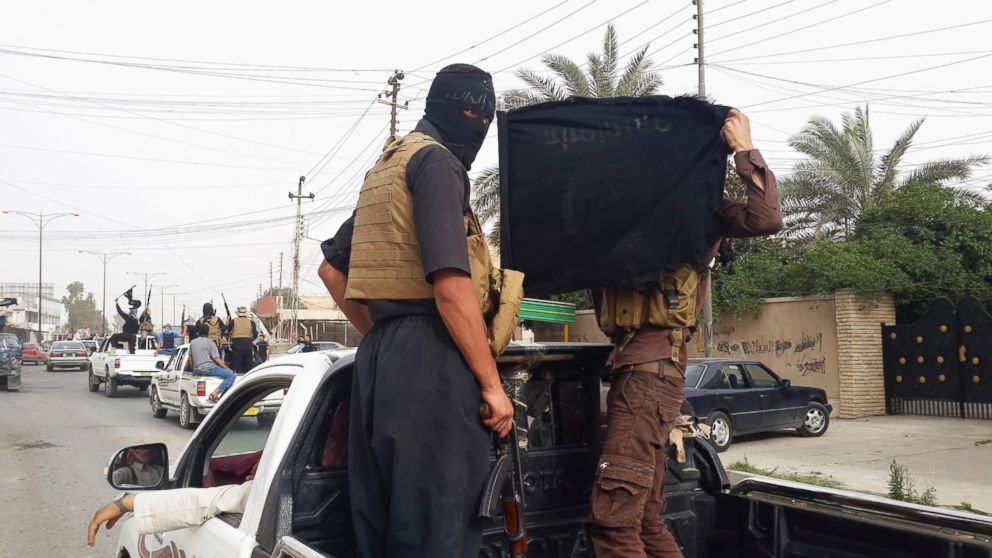
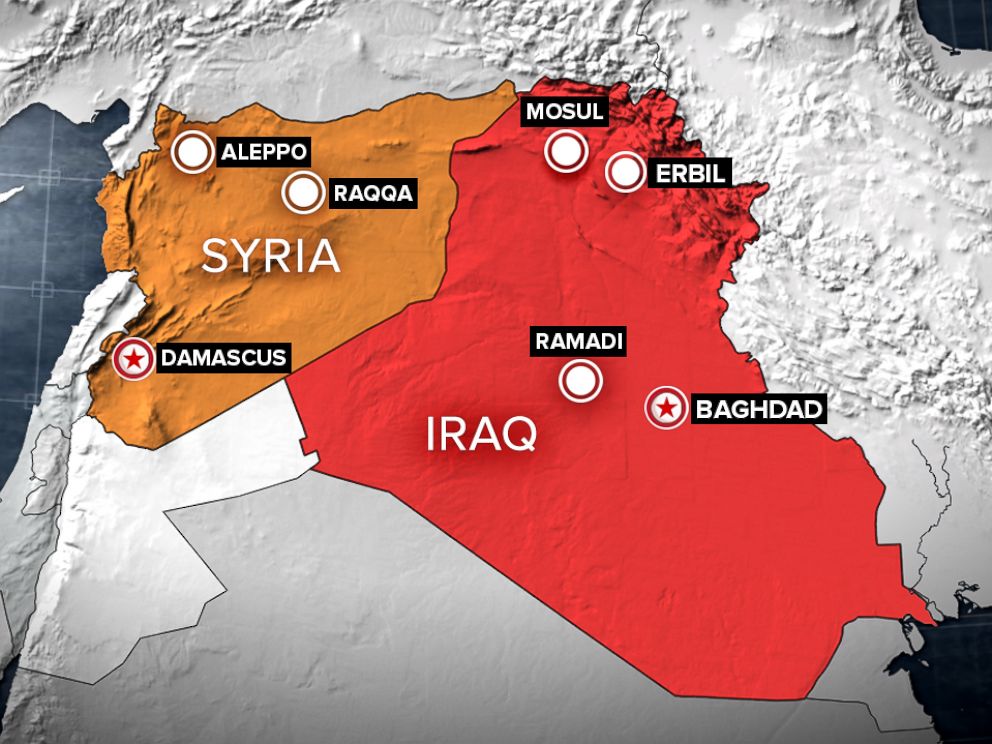
Airstrikes against up to 20 ISIS (Islamic State of Iraq and Syria) targets are under way in Syria,
according to Pentagon officials. The operation marks the first time the
U.S. has launched strikes in Syria, a new front in the battle against
the terror group.
"I can confirm that U.S. military and partner nation forces are
undertaking military action against ISIL [ISIS] terrorists in Syria
using a mix of fighter, bomber and Tomahawk Land Attack Missiles,"
Pentagon Press Secretary Rear Admiral John Kirby said. "Given that these
operations are ongoing, we are not in a position to provide additional
details at this time. The decision to conduct theses strikes was made
earlier today by the U.S. Central Command commander under authorization
granted him by the commander in chief."
Several Arab nations are involved in the ongoing U.S.-led operation, a
defense official said. A diplomatic source identified the nations as
Jordan, Saudi Arabia, Bahrain, Qatar and the United Arab Emirates.
Another U.S. official said the Arab nations will be dropping bombs, not
just providing support. Up to 20 locations have been targeted in the
operation, many of the sites in Raqqa, the official said.
Last week Defense Secretary Chuck Hagel told Congress that the U.S.
military's plan for potential action in Syria included "targeted actions
against ISIL [ISIS] safe havens in Syria, including its command and
control, logistics capabilities and infrastructure." Other officials had
said before that surveillance aircraft have been flying over Syria for
weeks gathering information on potential ISIS targets such as training
camps, command and control areas, warehouses, and supply routes.
In a national address
on Sept. 10, President Obama said the first part of his strategy to
counter ISIS was to “conduct a systematic campaign of airstrikes against
these terrorists.”
“Moreover, I have made it clear that we will hunt down terrorists who
threaten our country, wherever they are. That means I will not hesitate
to take action against ISIL [ISIS] in Syria as well as Iraq,” Obama
said. “This is a core principle of my presidency: If you threaten
America, you will find no safe haven.”
PHOTO: Iraq Syria Map - ABC News
The stealth F-22 Raptor took part in the mission, a U.S. defense official said, marking the first time the pricey, controversial aircraft has been used in a combat operation.
In recent weeks, a self-described ISIS militant is believed to have
killed two Americans on camera, journalists James Foley and Steven
Sotloff, as well a British aid worker. The group is suspected of holding
at least two more Americans and has publicly threatened a second
Briton.
As of earlier today the U.S. had launched nearly 200 strikes against ISIS in Iraq.
On Sunday, U.S. Ambassador to the United Nations Samantha Power told ABC
News’ “This Week” that America would not conduct airstrikes in Syria
alone. But already Secretary of State John Kerry claimed that some 40
countries, including a number of Arab nations, have offered various
levels of support to the anti-ISIS effort. France announced last week it
would join in airstrikes in the battle against ISIS.
According to the article, the four countries are preparing 90,000 troops, 400 aircraft and 1,000 tanks for the massive joint maneuvers, which are to take place along the Syrian coast within a month.
The report states that Russian “atomic submarines and warships, aircraft carriers and mine-clearing destroyers as well as Iranian battleships and submarines will also arrive in Syria” and that Egypt has agreed to let 12 Chinese warships cross the Suez Canal for the exercises.
According to Israel Radio, Bouthaina Shaabana, a Syrian official and President Bashar Assad’s special adviser, said the reports about such a drill are “baseless” and false.
The IDF spokesman’s office called the report a “political matter” and declined to comment.
Iran is currently holding talks with six Western powers over the fate of its nuclear program. The talks, said to be held in a tense atmosphere in Moscow, seek to alleviate world concerns that the Islamic Republic is developing nuclear weapons.
Syria meanwhile faces international pressure to end a 15-month crackdown on local rebels trying to oust Syrian President Bashar Assad.
China and Russia have come to the aid of both countries in recent months at the UN Security Council, vetoing military intervention in Syria and expanded sanctions on Iran.
Russia and Syria on Tuesday denied an Iranian media report that Syria would host Russian, Chinese and Iranian military forces for joint exercises.
Iranian news agency Fars said 90,000 troops and hundreds of ships, tanks and warplanes from the four countries would take part in the war games on land and sea in Syria soon.
The Russian Defense Ministry called such reports "disinformation" and the Russian news agency Interfax quoted an adviser to Syrian President Bashar al-Assad as saying it was not true.
"There will be nothing like that. This is one of those (pieces of) false information that are distributed about (Syria)," Interfax quoted Bouthaina Shabaan, the adviser who was in Moscow on Tuesday, as saying.
Interfax said Shabaan was referring to a report on al-Arabiya television that was similar to the Fars article.
Russian Foreign Minister Sergei Lavrov warned on Saturday that international support for Syrian rebels would lead to "more blood" and the government could not be expected to willingly give in to its opponents.
Lavrov, whose country has vetoed three U.N. Security Council resolutions intended to increase pressure on Syria's government to end 16 months of violence,said Western and Arab nations should exert more influence on rebels to stop fighting.
He said "tragedy" could be imminent in the Syrian city of Aleppo, but indicated rebels would be at least partly to blame.
"Pressure must be put on everyone," Lavrov said at a joint news conference with Japanese Foreign Minister Koichiro Gemba after talks in the Black Sea resort of Sochi, President Vladimir Putin's summer base.
"Unfortunately, our Western partners prefer to do something a bit different and essentially, along with some countries neighboring Syria, encourage, support and direct the armed fight against the regime," he said.
"The price of all this is still more blood."
In the wake of the Security Council vetoes by Russia and China, the United States has said it will seek ways to tackle the crisis outside the U.N.
Gemba said it was "very serious moment" in Syria and it was primarily up to the government to stop the bloodshed.
"The position of the Russian side has great influence, and there is also the voice of the international community. We are counting on a constructive Russian position," he said, speaking through an interpreter.
Lavrov said Russia was calling on the government to "take the first steps" but that the rebels should not take advantage of any such government actions by occupying cities and towns.
"The city of Aleppo is occupied by the armed opposition and the next tragedy is brewing there, as I understand it," he said.
"Well-armed opposition groups are occupying cities, intending to create some sort of buffer zones for a transitional government. How can one expect that the Syrian government will say, 'Yes, go ahead, overthrow me,'" he said.
"This is unrealistic - not because we are holding onto the regime but because it just doesn't work," he said.
Iran is capable of producing nuclear fuel for ships but has no immediate plans to upgrade the level of its uranium enrichment, the nation's nuclear chief was quoted as saying in Sunday.
Fereidoun Abbasi said if it decides to, Iran would first declare its need for higher grade enriched nuclear fuel to the U.N.'s International Atomic Energy Agency. Iran is currently enriching uranium to 20 percent.
Abbasi's comments were reported by the semi-official Mehr news agency.
An Iranian parliamentary committee has approved a bill requiring the government to design nuclear-powered merchant ships and provide them with nuclear fuel.
Some lawmakers say Iran should enrich uranium to levels close to weapons grade to produce fuel for proposed nuclear-powered oil tankers.
The U.S. and its allies suspect Iran wants to develop nuclear weapons. Iran denies that.
Also Sunday, Iran's intelligence chief was quoted as saying about 30 suspects have been arrested in connection with the assassination last year of a nuclear electronics expert.
Heidar Moslehi also accused Western intelligence agencies — including the CIA, Israel's Mossad and MI6 in Britain — of working together to kill Iranian nuclear scientists, part of efforts to derail Iran's nuclear program. Britain and the U.S. have dismissed Iran's claims. Israel has remained silent.
Moslehi's comments, reported by the official IRNA news agency Sunday, gave no other details on the arrests, including whether they are new or among those previously announced.
At least five Iranian nuclear experts have been killed since 2010. In May, Iran hanged a man convicted in the killing of a nuclear physicist in early 2010.
Iran, a close ally of Syrian President Bashar al-Assad, plans to host a meeting of regional and other countries this week on ways to resolve the country's conflict, the official IRNA news agency reported on Monday.
However, only countries with a "realistic" stance on the conflict will be invited to the meeting on Thursday, IRNA quoted Deputy Foreign Minister Hossein Amir-Abdollahian as saying.
The report did not say which countries would be involved but without Saudi Arabia, Qatar and Turkey, all of whom back the opposition to Assad, it is unlikely to have a significant result.
The aim is to find "ways out of the current crisis, the return of stability and calm to that country and also supporting all constructive regional and international efforts", Abdollahian said.
Shi'ite Muslim Iran has steadfastly supported Assad in his struggle to crush the 17-month-old rebellion against his rule, although it had backed other uprisings which removed leaders in Egypt, Libya and Yemen.
Syria and Iran have accused Turkey, Qatar and Saudi Arabia of backing rebels in Syria and fuelling violence there.
The Iranian armed forces chief Seyed Hassan Firouzabadi warned the three countries against helping Washington's "war-raging goals" in Syria.
"Saudi Arabia, Qatar and Turkey are responsible for the blood that is being spilled in Syria," he said in comments published on the Revolutionary Guards' website.
"It is not the right basis for Syria's neighbouring countries to help the war-raging goals of America. If that is the basis...they should know that next, it will be Turkey's and other countries' turn," Firouzabadi said.
Iranian leaders have accused the West of plotting with Arab countries to overthrow the Syrian leadership and bolster the status of Israel in the region by backing extremist militant groups.
Last month, Iran said it was ready to host talks between the Syrian government and opposition groups, an offer rejected by members of the Syrian opposition.
Turkey sent batteries of ground-to-air missiles to the border with Syria on Sunday, media reports said, boosting its firepower as rebels in Syria seized several border posts.
As fighting raged in Damascus and Aleppo, rebels were said to have taken control of three crossing points on the border with Turkey, which is sheltering thousands of Syrians who have fled the conflict at home.
A train convoy carrying several batteries of missiles arrived in Mardin in southeastern Turkey and will be transferred to several army units deployed on the border, according to the Anatolia news agency.
Television footage showed at least five vehicles in the convoy were carrying air defence missiles, in the latest show of force by Syria's one-time ally which is now a fervent critic of President Bashar al-Assad's regime.
Turkish Prime Minister Recep Tayyip Erdogan warned last month after the downing of a military jet initially blamed on Damascus that it now regarded Syria as a "clear and imminent threat".
Syria has in turn accused Turkey of sheltering rebels and training and supplying militants fighting the regime in a conflict that erupted in March 2011 and has now claimed at least 19,000 lives according to activists.
Meanwhile, Syrian rebels were now in control of the Jarabulus, Bab al-Hawa and Al-Salama posts along the nearly 900-kilometre (560-mile) frontier with Turkey, a diplomat and Anatolia said.
An amateur video showed armed men celebrating the takeover of the Al-Salama post, north of Aleppo, which the diplomat said occurred early Sunday.
The crossing faces the Turkish border post of Oncupinar near Kilis in the southeast, where refugees at a camp there clashed with Turkish police after demonstrating over their living conditions.
The video footage supplied by the shows one fighter, who identifies himself as spokesman for the "Northern Storm Brigade" of the rebel Free Syrian Army, said the border post was now under their control.
"Bab al-Salama has been liberated from the hands of Assad's mafia, after a suffocating siege on them," he said, without giving his name.
Regime forces "withdrew after suffering losses", he added, describing Turkey as a "sister nation".
Several men standing behind him hold up their weapons to celebrate, chanting: "Allahu Akbar! (God is greatest)".
The man called the takeover of the outpost a step on the road "to liberate Aleppo, and then Damascus, and then the presidential palace".
Anatolia reported that rebel fighters took Al-Salama after hours of fighting during the night, and that the sounds of the battle could be heard from the Turkish side of the border.
On Tuesday, rebels took control of the Jarabulus border post, north of Lake Assad in Aleppo province.
Rebel forces gained control of the Bab al-Hawa crossing on Thursday, but on Saturday, a group of some 150 foreign fighters were in control of the post, an AFP photographer said.
Some fighters said they belonged to Al-Qaeda in the Islamic Maghreb (AQIM), while others claimed allegiance to a group called Shura Taliban. They were armed with Kalashnikov assault rifles, rocket launchers and improvised mines.
Israel is upgrading its Arrow II ballistic missile shield in a U.S.-backed "race" against Iran, Syria and other regional enemies, a senior Israeli defense official said on Sunday.
The new "Block 4" generation of guided interceptor rockets, radars and technologies for synchronizing Arrow with U.S. systems was being installed in deployed Israeli batteries, a process that would take several weeks, the official said.
"The accuracy and the reach will be greater," the official said of Arrow, which has been operational since 2000 and is designed to blow up incoming missiles at altitudes high enough for non-conventional warheads to disintegrate safely.
"It is part of the technological race in the region," the official, who declined to be named, told Reuters.
Long jittery about Iran's disputed nuclear program, the Israelis have more recently worried the Syrian insurgency could loosen Damascus's hold on its chemical weapons and missiles.
Israel has threatened to attack preemptively in both countries, a prospect that could trigger wider war and clash with Washington's efforts to resolve the crises diplomatically.
Iran, which denies seeking nuclear weapons, has repeatedly vowed to retaliate against any attack.
"(Israel) knows that attacking Iran is an unattainable wish, unless the regime seeks to commit suicide," Iranian Defense Minister Ahmad Vahidi was quoted as saying by the state news agency IRNA on Sunday.
The Pentagon and U.S. firm Boeing Co are partners in Arrow, an investment that the Obama administration hopes will help stay Israel's hand.
U.S. Secretary of Defense Leon Panetta said last week that Israeli interceptors like Arrow and Iron Dome, which shoots down short-range guerrilla rockets, were "designed to prevent wars".
Arrow has scored a 80 percent to 90 percent success rate in field tests, system designer Uzi Rubin told Israel's Army Radio.
ALLIES
"It's always undergoing changes and improvements, as well as adaptations to new threats," Rubin said.
Iran on Saturday unveiled a new short-range missile which it said was capable of striking land and sea targets. Syria, for its part, last month went public with its chemical arsenal, saying it was intended for last-resort use against "external aggression".
Tehran also has Islamist guerrilla allies in Lebanon and Gaza who could shell neighboring Israel during any regional conflict. Their short-range rocket arsenals have been expanding and improving as well, the senior Israeli defense official said.
Having helped underwrite Arrow, the Americans were free to draw on its technologies for their own uses, the official said.
"The policy of the (Israeli) Ministry of Defense is to provide all data to the U.S., for the security of the U.S., including on targets, interceptors, radars and command and control," the official said.
With Congress also lavishing cash on Iron Dome, some U.S. lawmakers have called on Israel to share that system, too.
The Israeli official said that though Iron Dome was different to Arrow as it was developed entirely by Israel, the current policy was to provide the Americans data upon request while a more permanent arrangement is negotiated.
In parallel to Arrow II, Israel is developing Arrow III, which is due to be operational in 2014 or 2015. Unlike previous generations of the interceptor, Arrow III will engage incoming missiles in space, using detachable warheads that, turning into "kamikaze" satellites, will seek out and slam into the target.
Israel is also working on a more powerful rocket interceptor than Iron Dome, known as David's Sling or Magic Wand, which is due out next year. Meshed together and with U.S. counterparts, the three Israeli systems would form a multi-tier shield providing several opportunities to intercept incoming missiles.
A senior Israeli official denied on Sunday a newspaper report that President Barack Obama's national security adviser had briefed Israel's Prime Minister Benjamin Netanyahu on a U.S. contingency plan to attack Iran should diplomacy fail to curb its nuclear program.
The Israeli liberal Haaretz daily on Sunday quoted an unnamed U.S. official as saying the adviser, Thomas Donilon, had described the plan over dinner with Netanyahu earlier this month.
"Nothing in the article is correct. Donilon did not meet the prime minister for dinner, he did not meet him one-on-one, nor did he present operational plans to attack Iran," the senior official, who declined to be named given the sensitivity of the issue, told Reuters.
Haaretz said the briefing was the most significant effort by high-level U.S. officials who had visited Israel in the past month, including Secretary of State Hillary Clinton, to try to dissuade Israel from launching its own military strike on Iran.
The report coincided with a visit to Israel by Obama's main rival in his reelection bid this November, Republican candidate Mitt Romney, who was due to meet the conservative Netanyahu on Sunday.
Haaretz said Donilon had told Netanyahu the Pentagon was planning for a possible decision to attack Iran's nuclear sites, and had shown him some of the plans.
The failure of talks between Iran and six world powers to secure a breakthrough in curbing what the West fears is a drive to develop nuclear weapons has raised international concerns that Israel, widely assumed to be the Middle East's only nuclear-armed state, may opt for a go-it-alone military strike.
Israel has warned the West it thinks it is only a matter of time before Iran's nuclear programme achieves a "zone of immunity" in which bombs will not be able to effectively strike uranium enrichment facilities buried deep underground.
Iran says its programme is solely for peaceful purposes.
On a visit to Jerusalem this month, Clinton said Israel and Washington were "on the same page" with respect to Iran, calling Iran's latest proposals to world power talks on the issue "non starters."
"Our own choice is clear, we will use all elements of American power to prevent Iran from obtaining a nuclear weapon," Clinton said.
A number of Palestinian refugees living in Damascus have joined the uprising in Syria, according to activists and rebels, with some taking up arms alongside rebel Free Syrian Army fighters.
The majority of at least 500,000 Palestinians in Syria have been living in the country since the 1948 creation of Israel, and the Syrian regime has systematically striven to control their political activity.
Most of the refugees joining the anti-regime revolt are not affiliated to traditional Palestinian factions or movements, according to activists.
"Many of us -- especially the youth -- are in sympathy with the revolution, and now that the fighting is in Damascus, we cannot stay put," a Palestinian from Yarmuk refugee camp, on the outskirts of the capital, told AFP.
"Many Palestinian youth have joined the FSA, and they are fighting side by side with the Syrian revolutionaries in the Tadamon and Al-Hajar Al-Aswad districts," said the activist, who identified himself as Abu al-Sakan.
Abu al-Sakan said sympathy for the uprising has grown among Palestinians, especially as more and more Syrians displaced from Homs, Daraa and Hama in the provinces seek refuge in or around the refugee camps in Damascus.
With fighting raging in nearby Tadamon, Al-Midan and Al-Hajar Al-Aswad districts, hundreds of civilians have sought shelter since last week in Yarmuk camp, activists say, stoking fears the army might launch an attack on the area.
Though the camp was calm on Tuesday, it was difficult for people to leave and gunfire could be heard from neighbouring areas.
Demonstrations in the camp have become common, activists say. Last Friday, thousands of people -- Palestinians and Syrians -- took part in a protest that started off from mosques in the area, a witness said.
Colonel Kassem Saadeddine, spokesman for the FSA's Homs-based joint command, told AFP on Tuesday that "Palestinians are fighting alongside us, and they are well trained."
The regime has accused the West, Gulf states and Israel of conspiring against Syria, while boasting it hosts half a million Palestinian refugees and supports their people's struggle for statehood.
"The regime says it supports the Palestinians and gives us equal rights," said Abu al-Sakan.
"In fact this means we are treated in exactly the same brutal way as the Syrians. It is just as ready to kill us," he said, adding that "just like the Syrians are divided over the revolt, so are the Palestinians."
Activists say the most support for the uprising comes from young Palestinians disaffected with traditional party factions.
The mainstream Fatah has historic qualms with the regime. Its activists were heavily persecuted by the Syrian regime during the 1980s, but they have tried to remain neutral in the domestic conflict.
An ex-Fatah member and former political detainee in Syria's dreaded prisons, speaking to AFP on condition of anonymity, said Fatah loyalists in Damascus silently despise the regime but fear the consequences if Islamists take over.
"Palestinians have also paid the price of Arab countries' struggles for decades. So most Fatah supporters are trying to stay on the fence," explained the former detainee.
"But it is difficult because even if they do not go to the revolt, the revolt is coming to them."
The Palestinian Islamic movement Hamas, the bulk of whose politburo was based in Damascus until February, may have distanced itself from the regime but without publicly supporting the revolt.
Another Damascus-based faction loyal to President Bashar al-Assad, the Popular Front for the Liberation of Palestine-General Command, argued on July 3 that the uprising was not a genuine local movement.
It was part of "a change in the foundations of this region in order to create a new Middle East."
Echoing the Assad regime, PFLP-GC spokesman Anwar Raja said the Palestinians were "convinced that the political regime in Syria is facing a war to divide the country and to dismantle its relations with the (Palestinian) resistance."
Raja said most of the demonstrators were Syrians from outside the camp and "there was only a limited number of Palestinians. We think the (Israeli spy agency) Mossad benefits from all the destructive actions in Syria."
In a statement issued on Monday night, the FSA's joint command warned that pro-regime Palestinian leaders on Syrian soil were "legitimate targets."
For his part, Abu al-Sakan slammed the PFLP-GC's stance.
"As Palestinians we have two revolutions: one against the Palestinian factions which do nothing for us, and another against the Syrian regime," he said.
President Putin offered no indication that Russia will support a UN Security Council resolution backed by the US, Britain, and France that would open the door for military intervention.
Christian Science Monitor July 17, 2012
Hopes for a diplomatic compromise between Russia and the West over any kind of an orderly transition from the regime of Bashar al-Assad petered out Tuesday – amid fulsome support for peace and civic accord in Syria from Russian President Vladimir Putin.
Meeting in the Kremlin with UN envoy Kofi Annan, even as fighting raged in the streets of Damascus, President Putin insisted that the Kremlin will "do everything" to back the faltering six-point peace plan, which envisages a cease-fire, UN observers on the ground, and talks between rebels and regime over a transitional government.
"From the very start, from the first steps, we supported and continue to support your efforts aimed at restoring civil peace," Putin told Mr. Annan, according to Russian news agencies. "We will do everything that depends on us to support your efforts," he added.
But the Kremlin leader offered no indication that Russia will support a UN Security Council resolution to be put forward Wednesday. The proposed resolution, backed by the US, Britain, and France, would extend the UN observer mission by 45 days – the mandate is otherwise set to expire on Friday – but would put future implementation of the Annan plan under Chapter 7 of the UN Charter, which might open the door to the legal use of outside force.
On Monday, Russian Foreign Minister Sergei Lavrov accused the West of employing "blackmail," by threatening to block any renewal of the UN observers' mandate unless Russia backed a Chapter 7 resolution on Wednesday.
"What do you expect? For Russia, Syria means access to the Middle East. There are 80,000 Russian-speakers living there, and the Russian Orthodox Church insists that Russia must act to protect the Christian minority in that country," says Vladimir Yevseyev, an expert with the official Institute of World Economy and International Relations in Moscow.
Last year then-Russian President Dmitry Medvedev ordered Russia's UN envoys to abstain on Resolution 1973, which authorized the use of force to protect civilians in Libya but developed into a rebel drive for regime change backed by NATO airpower. Russia has vowed not to allow any similar resolution about Syria to pass the Security Council.
"Medvedev isn't president anymore, there's another person at the top in Russia now, and that's Putin," says Mr. Yevseyev. "It's senseless to try to pressure Putin; in fact it might lead to the opposite result."
COMING TO A COMPROMISE?
Foreign Minister Lavrov said Tuesday that Russia might reach a compromise with the West similar to the one that was forged at a meeting of leading powers in Geneva last month. But that deal only saw the light of day after all language calling for Assad's removal or any sort of outside intervention in the conflict was removed from the draft resolution on Russia's demand.
"I would hope that the [Security] Council will continue its discussions and hopefully find language that will pull everybody together for us to move forward on this critical issue," he said.
"In effect, this tells us that all avenues for diplomacy have already been pretty much exhausted," says Sergei Strokan, a foreign policy columnist with the Moscow business daily Kommersant.
"It's all about 'red lines' now. For the West, it's any role for Assad in any future Syrian government. For Russia, the red line is any kind of outside intervention, especially based on a Chapter 7 resolution.... Everybody's talking about peace and political solutions, but in fact diplomacy is totally deadlocked," he says.
"Why should Russia be so stubborn, right up to the bitter end? You have to understand that for Moscow this isn't just about Syria. It's about the mechanism for solving such situations. Putin wants to prevent any precedent that might authorize the use of outside force to engineer change in a crumbling authoritarian regime, wherever it may be," Mr. Strokan adds.
"Maybe next time it might be Belarus or, who knows, one day even Russia?"
A Russian ship that tried to supply attack helicopters to Syria last month before being forced back was Sunday sighted sailing back home after unexpectedly starting a new voyage.
The privately-chartered Alaed had to return to Russia after its initial attempt to deliver the controversial cargo to President Bashar al-Assad's regime in June was exposed by the US State Department.
The 9,000-tonne private cargo was forced to turn back when its British insurer ended up pulling coverage.
The ship then docked in an Arctic port before setting sail again on Tuesday following pledges by Russian military officials to complete the delivery despite the anger it caused in the West.
The timing of the second voyage sparked alarm as it coincided with the deployment of a Russian flotilla to the Mediterranean that could have provided protection from any foreign attempt to block the ship.
The Russian arms export agency on Friday confirmed that the helicopters were aboard the Alaed when it set sail for the second time but refused further comment.
The MarineTraffic.com website that tracks global maritime activity showed the Alaed's radar signal coming in Sunday just north of Denmark following the ship's southern passage along the Norwegian coast.
The ship was shown to be sailing eastward to the Baltic Sea -- in line with suggestions from the owner that it would dock in Saint Petersburg after making a brief port call in the Kaliningrad exclave in the coming days.
Russian officials had earlier suggested that the shipment -- originally also carrying air defence systems that have not been mentioned in more recent reports -- may eventually be delivered to Syria by air.
The three Mi-25 helicopters were repaired in Kaliningrad and some analysts believe that they may be dropped off there by the Alaed before its goes on to Saint Petersburg to pick up new cargo.
Moscow has vowed to fulfill a helicopter repair contract it signed with its last Middle East ally in 2008 while promising not to supply any of its latest technology to Assad while the fighting in Syria continues.
Syrian President Bashar al-Assad will use chemical weapons against opposition forces and may have already deployed them, Nawaf Fares, the first Syrian ambassador to defect, told the BBC on Monday.
Fares, the most prominent politician to defect since the uprising against Assad began, insisted that the president's days were numbered but warned he would be prepared "to eradicate the entire Syrian people" to remain in power.
When asked by the BBC's Frank Gardner whether that would mean the use of chemical weapons, Fares said: "I am convinced that if Bashar al-Assad's regime is further cornered by the people -- he would use such weapons."
"There is information, unconfirmed information, that chemical weapons have been used in Homs," the former ambassador to Iraq added.
Syria has a large stock of chemical weapons and neighbouring countries are increasingly concerned about what will happen to them if the regime topples.
Fares said this outcome was now "inevitable".
"It is absolutely sure that this government will fall in a short time," he told the BBC from his refuge in Qatar. "We wish for this time to be short so that more sacrifices are reduced."
Fares, who announced his defection on July 11, was widely seen as a regime hardliner and his decision to break ranks has triggered suspicion among activists.
Some dissidents say Fares has been likely groomed by the West to play a role in a transitional government while others have spoken about his "criminal" past.
Fares, who has served as governor in several Syrian provinces and has held senior security and Baath party posts, hails from the prominent Oqaydat Sunni tribe in eastern Syria, which also has members in Iraq, Jordan and Saudi Arabia.
A former policeman, Fares had close ties to the dreaded intelligence services before becoming governor and later Syria's first ambassador to Iraq following a 30-year rupture in ties between the two neighbours.
Syria's military deployed armoured vehicles near central Damascus on Monday as troops battled rebels around the capital in what activists said could be a turning point in the 16-month uprising.
Fares said the spread of violence to the capital proved that the "expansion and the power of the revolution was increasing day-by-day."
The United States and Israel collaborated to create the Flame computer virus as part of an effort to slow Iran's suspected nuclear weapons drive, The Washington Post reported Tuesday.
The newspaper, citing "Western officials with knowledge of the effort," said the sophisticated malware was designed to spy on Iran's computer networks and send back intelligence used for an ongoing cyberwarfare campaign.
The Post said the US National Security Agency and CIA worked with Israel's military on the project.
A number of reports had linked Israel and the United States to Flame and another virus called Stuxnet which caused malfunctions in Iran's nuclear enrichment equipment.
US officials have not publicly discussed the matter except to say that they are focused on cyber efforts as part of defense and intelligence.
"This is about preparing the battlefield for another type of covert action," one former high-ranking US intelligence official told the Post.
The Russian security firm Kaspersky, first credited with discovering Flame, said last week the malware had strong links to Stuxnet.
Kaspersky said its research shows the two programs share certain portions of code, suggesting some ties between two separate groups of programmers.
The New York Times reported June 1 that President Barack Obama accelerated cyberattacks on Iran's nuclear program and expanded the assault even after the Stuxnet virus accidentally escaped in 2010.
The cyberattack, aimed at preventing Iran from developing nuclear weapons and keeping Israel from launching a preventive military strike, sowed widespread confusion in Iran's Natanz nuclear plant, the Times said.
President Mahmoud Ahmadinejad appeared to indicate that Iran would be prepared to stop high-grade uranium enrichment - a demand of the United States and its allies - if world powers agreed to meet its needs for the fuel.
"From the beginning the Islamic Republic has stated that if European countries provided 20 percent enriched fuel for Iran, it would not enrich to this level," Ahmadinejad stated in comments published on his presidential website.
Meeting to discuss Iran's nuclear program in Moscow on Monday, world powers are to push for the suspension of its high-grade uranium enrichment activities over fears Iran is seeking to develop nuclear weapons capability. Tehran denies this.
Russia and Syria on Tuesday denied an Iranian media report that Syria would host Russian, Chinese and Iranian military forces for joint exercises.
Iranian news agency Fars said 90,000 troops and hundreds of ships, tanks and warplanes from the four countries would take part in the war games on land and sea in Syria soon.
The Russian Defense Ministry called such reports "disinformation" and the Russian news agency Interfax quoted an adviser to Syrian President Bashar al-Assad as saying it was not true.
"There will be nothing like that. This is one of those (pieces of) false information that are distributed about (Syria)," Interfax quoted Bouthaina Shabaan, the adviser who was in Moscow on Tuesday, as saying.
Interfax said Shabaan was referring to a report on al-Arabiya television that was similar to the Fars article.
Syria is but a chess piece being used as a platform by larger powers. Regime change is the unwavering interest of the US-led NATO block in collaboration with the feudal Persian Gulf Monarchies of the Gulf Cooperation Council (GCC). This is being accomplished by using Qatar-owned media outlets such as Al-Jazeera to project their version of the narrative to the world and by arming radical factions of the regions Sunni-majority population against the minority Alawi-Shia leadership of Assad. - The Road To Tehran Goes Through Damascus, NileBowie.blogspot.com, February 15, 2012
Reuters June 13, 2012
Russia's foreign minister on Wednesday defended his country's sale of arms to Syria and accused the United States of supplying rebels with weapons to fight against the government.
U.S. Secretary of State Hillary Clinton said on Tuesday Washington was worried Russia may be sending attack helicopters to Syria and described as "patently untrue" Moscow's argument that its arms transfers to Syria are unrelated to the conflict there.
"We are not violating any international law in performing these contracts," said Sergei Lavrov, in response to a question about Clinton's comments at a news conference during a visit to Iran.
"They are providing arms and weapons to the Syrian opposition that can be used in fighting against the Damascus government," he said on Iranian state television, speaking through an interpreter.
Russia is one of Syria's principal defenders on the diplomatic front and, as a permanent member of the U.N. Security Council with the power to veto resolutions, has stymied efforts by Western powers to pressure President Bashar al-Assad into stepping down.
Lavrov said Russia's position was based on concern for the Syrian people and the country's integrity, rather than personal preference for Assad.
"I have announced time and again that our stance is not based on support for Bashar al-Assad or anyone else ... We don't want to see Syria disintegrate."
Russia is resisting Western and Gulf Arab pressure to take a harder line against Assad, rejecting calls for sanctions and proposing a conference bringing together global and regional powers including Iran.
Iranian Foreign Minister Ali Akbar Salehi said the Syrian crisis could not be resolved by external powers.
"The Islamic Republic of Iran has announced many times: the issue of Syria needs to be dealt with in Syria by Syrians, not through the interference of others"
The United States says it does not believe Iran, Assad's closest regional ally, is ready to play a constructive role in Syria, where the United Nations says government forces have killed more than 10,000 people since March 2011.
Almost half a million metric tonnes of grain has arrived at Iran's major food port and Turkish banks are being used by the Islamic Republic as an alternative trade financing route to sidestep Western sanctions, trade sources say.
Iran has been shopping for wheat at a frantic pace, ordering a large part of its expected yearly requirement in a little over one month and paying a premium in non-dollar currencies to work around toughened sanctions and avoid social unrest.
"With any number of unknowns out there - a potential attack on its nuclear facilities, the possibility that a different administration takes office in the United States, the regime is prudently laying aside (food) stocks in the event things go very wrong," said J. Peter Pham, a director with U.S. think tank the Atlantic Council.
Food shipments are not targeted under western sanctions aimed at Iran's disputed nuclear program, but financial measures have frozen Iranian firms out of much of the global banking system. State-run Government Trading Corporation (GTC) has stepped in to make recent purchases as private Iranian buyers have been sidelined.
"There is not a problem with payments, things are settling down using non-sanctioned banks," one trade source said. "The GTC is using Turkish banks to make payments."
Iran bought around 2 million tonnes of wheat just last month from Russia, Germany, Canada, Brazil and Australia.
Sanctions are worsening an economic crisis which has caused rising prices, shortages of some goods and a collapse of the local currency at a time when other countries in the Middle East are experiencing political and social unrest.
WORKING AROUND THE EMBARGO
Trade sources said Iran was making payments in euros and also U.S. dollars via non-sanctioned banks.
"Apart from Turkish banks, Iran is also facilitating deals via Switzerland and is also using cash in smaller trades as well as even gold," another trade source said. "They are working around the restrictions."
AIS ship tracking data on Reuters showed 12 dry bulk vessels on Friday were anchored outside Bandar Imam Khomeini, one of Iran's largest grain terminals.
At least six of the vessels were larger ships known as panamaxes, which can carry around 60,000 tonnes of grains. A further panamax was on its way to the terminal. Four vessels including one panamax ship had left the port area for new destinations in recent days after unloading, data showed.
"It is still hard to assess the volume of wheat Iran has bought on international markets in recent weeks," another trade source said. "Conservative estimates are 1.5 million tonnes others put the figure at well over 2 million tonnes."
"Most of this is for nearby shipment so I would expect more ships to be arriving in Iranian Gulf ports in coming weeks."
Earlier this month it was revealed Iran had made rare purchases of around 180,000 tonnes of U.S. wheat. Trade sources said there was growing talk of further U.S. purchases despite the escalating standoff with Washington and its allies.
Iran continues to seek large volumes of wheat from sources out of reach of western sanctions. Pakistani officials said on Monday a barter deal for 1 million tonnes had been reached, but an Indian trade delegation failed to agree rupee-based wheat sales.
Payment problems resulting from sanctions halted some deliveries to private Iranian buyers since the start of this year. Ten vessels turned away from Iran to new destinations including Yemen, the United Arab Emirates and Egypt, incurring big losses. The last of them sailed away earlier this month.
"Iran has a lot of money and after a few early problems things are flowing," another trade source said. "We are being paid via Turkey."
The Atlantic Council's Pham said the U.S. was reluctant to impose onerous trade burdens on allies. Earlier this week it granted waivers to Japan and 10 EU countries from financial sanctions after they cut their Iranian oil import purchases.
"The Iranians took it as a signal that if they structured their deals in a complex enough fashion and selected as their partners nominal U.S. allies whom Washington would be loath to have an open and complete rupture with, they might just be allowed to get away with it. Turkey is a good example," he said.
May 22, 2012
North Korea to Boost Nuclear Deterrent after U.S. Pressure
Isolated North Korea stepped up its war of words against the United States on Tuesday, vowing to boost its nuclear deterrent after Washington warned Pyongyang of further sanctions if it did not abandon its atomic program.
The North's foreign ministry spokesman said via the official KCNA news agency that it would "bolster its nuclear deterrent as long as the United States was continuing with its hostile policies" and that it planned "countermeasures" following pressure from Washington.
Last week, world leaders meeting in the United States said the isolated North needed to adhere to international norms on nuclear issues and said it would face more isolation if it "continues down the path of provocation".
Under new leader Kim Jong-un, North Korea launched a long range rocket in April, breaking an agreement with the United States that would have traded food aid for access to its nuclear facilities, among other things.
Many experts now believe the reclusive North is preparing for a third nuclear test, and could even use highly enriched uranium for the first time. Experts say the North already has enough fissile material from plutonium for at least six nuclear bombs.
U.S. Special Representative for North Korea Policy Glyn Davies told reporters in Seoul on Monday that North Korea could expect "a swift and sure" reaction by the international community if it undertook further hostile actions.
Davies was holding talks with his Chinese counterpart in Beijing on Tuesday.
China is North Korea's sole major economic and diplomatic backer and even it has put pressure on Pyongyang to back down on plans for a nuclear test.
Yang Moo-jin, a professor at the University of North Korean Studies in Seoul, was skeptical that the latest rhetoric from Pyongyang signaled a nuclear test was imminent.
"North Korea is simply saying: Don't agitate or provoke us," he said.
Recent satellite imagery published by IHS Jane's Defense Weekly, a specialist defense publication, showed there had been more work at the site of previous nuclear tests that could indicate the North was preparing for its third nuclear test.
The Janes analysis showed mining carts and excavation equipment as well more debris from inside a tunnel that could be used for a third nuclear test.
"A third nuclear test by North Korea would be the latest move in restarting its nuclear weapons program, which it agreed to mothball in a 29 February deal with the U.S.," said Janes analyst James Hardy.
Since the death of Kim Jong-il in December, Kim Jong-un, believed to be in his late 20s, has shown he will continue with his father's hardline "military first" policy.
January 30, 2012
China, India and Russia Have Bilateral Agreements with Iran to Buy Oil; U.S. 'Disgusted' by Russia, China Veto of Syria Resolution
ABC OTUS News -The United States is "disgusted" by Russia and China's decision to veto a U.N. Security Council resolution today that called for an immediate end to the violence in Syria, U.S. Ambassador to the U.N. Susan Rice said today.
The Security Council vote today came on one of the bloodiest days of the popular uprising in Syray, as President Bashar al Assad's security forces launched a withering artillery assault on the city of Homs that has reportedly left 200 to 400 dead.
Though they were the only negative votes in a 13 to 2 vote, Russia and China's veto power as permanent members of the Security Council killed the resolution drafted by Arab and European countries.
The vetoes came after a week of intense negotiations to gain Russian support for a resolution it had opposed from the start. The resolution supported an Arab League plan that called for an immediate end to the violence in Syria and a political solution to the crisis. Russia was opposed to the resolution because of concerns that it could leave an opening for a foreign intervention against one of its loyal client states.
The vetoes drew harsh criticism from Security Council members that supported the resolution and who had amended it several times to ease those concerns, rewording language about the transition of power and watering down the possibility of future sanctions against the Assad regime.
"The United States is disgusted that a couple of members of this Council continue to prevent us from fulfilling our sole purpose," U.S. Ambassador Susan Rice said.
"For months this Council has been held hostage by a couple of members," she said, referring to Russia and China, who she said had been "delaying and stripping bare any text to force Assad to stop his actions."
Without referring to Russia by name, she said the vetoes were "even more shameful" given that Russia has continued to sell weapons to to Syria. She called the vetoes "unforgivable" and said "any further blood that flows will be on their hands."
In brief remarks to the Council, Russian Ambassador Vitaly Churkin said Russia actively supports an end to the violence in Syria, but that the resolution did not "accurately reflect the real state of affairs" in Syria and "sent an unbalanced signal to the parties." Churkin was speaking about armed opposition groups that have also been conducting violent attacks against the Assad regime in Syria.
He once again cited Russian concerns about "regime change" by "influential members of the international community who have been undermining the possibility of a settlement in Syria."
French Ambassador Gerard Araud said the vetoes were a "sad day for the UN Security Council … a sad day for democracy and a sad day for Syrians. … Hundreds of Syrians are dying and it is no longer possible to wait. "
Peter Wittig, the German ambassador to the United Nations criticized the vetoes particularly for having come on "one of bloodiest days of the Arab spring" and the 30th anniversary of the massacre in Hama, Syria ordered by Assad's father that resulted in 20,000 dead.
"This is the real scandal," Wittig said. "Afraid this will spur further violence and make it difficult to reach a political solution."
British Ambassador to the U.N. Mark Lyall said Russia and China should "ask themselves how many more deaths they are prepared to tolerate." He said the negotiations had "removed every possible excuse" for voting against the resolution. He also said that the United Kingdom and other countries would continue their efforts to stop the violence in Syria.
Li Baodong, China's Ambassador to the UN told Council members that China voted against the resolution because it would "further complicate the situation" in Syria.
He also said that China supported the Russian delegation's last minute calls for a delay on the vote as well as amendments proposed by Russia that were not taken up by the Council.
Iran is the fifth largest producers of oil in the world.
In what is likely a long overdue move, Iran has finally decided to give Europe a harsh lesson in game theory. Instead of letting Euro-area politicians score brownie points at its expense by threatening to halt imports and cut off the Iranian economy, the Iranian government will instead propose a bill calling for an immediate halt to oil deliveries to Europe.
The move, with most reports citing the Iranian news agency Mehr, has come about in response to the EU agreement to impose sanctions against Iran, which were announced earlier this week. And why not? After all if Europe is indeed serious, sooner or later Iran will be cut off but in the meantime experience significant policy uncertainty, which is precisely what the flipflops on the ground need. The one thing that Europe, however is forgetting, is that all that whopping 0.8 Mb/d in imports will simply find a new buyer. Quickly.
So with China, India and Russia already having bilateral agreements with Iran in place, we are confident that said buyer will have a contract signed, sealed and delivered within an hour of the proposed bill's passage.
Furthermore, as SocGen speculated, the fact that Europe will be even more bottlenecked in its crude supplies (good luck Saudi Arabia with that imaginary excess capacity), and which just may force the IEA to release some more of that strategic petroleum reserve (and thus give JPM some more free money on the replenishment arbitrage) will send Brent to $125-150 - something which Iran will be delighted by.
That is of course unless some "experts" discover that Iran may or may not have a complete arsenal of shark with fricking nuclear warheads attached to their heads (despite what Paneta has already said) which gives the US the green light for a full blown incursion,which in turn will send oil over $200, and the world economy into a global coordinated re-depression.
"If this bill is passed, the government will be forced to stop selling oil to Europe before the actual implementation of their sanctions," said Emad Hosseini, spokesman for the Iranian parliament's energy commission, reportedly said. The bill is set to become law on Sunday.
The EU sanctions allow for oil deliveries from Iran until July 1. Any pre-empting of this timescale by Tehran could prove problematic for countries like Italy, Greece and Spain, who would need to urgently find new suppliers.
China, meanwhile, a major importer of Iranian oil, has also criticized the EU sanctions. The Xinhua news agency quoted the Chinese Foreign Ministry on Thursday as saying: "To blindly pressure and impose sanctions on Iran are not constructive approaches."
Many members of the EU are now heavily dependent on Iranian oil. Some 500,000 barrels arrive in Europe every day from Iran, with southern European countries consuming most of it. Greece is the most exposed, receiving a third of all its oil imports from Iran, but Italy too depends on Iran for 13 percent of its oil needs. If this source were to dry up abruptly, the economic conditions in the two struggling countries could become even worse.
Already on Wednesday, the International Monetary Fund (IMF) warned of the economic consequences of the EU's planned embargo. Stopping deliveries from the world's fifth largest producer could drive up the price of oil by 20 to 30 percent.
Perhaps instead of doing its best at crippling the world energy markets, and crushing the global economy, Europe should stick to bailing itself out, and other activities in which it has extensive experience.
Iran Won't Give Up Its Right to Enrich Uranium and Produce Nuclear Fuel, But It Will Allow Inspectors to Visit Its Nuclear Sites to Ensure That Its Nuclear Program Won't Be Weaponized
Iran is ready to revive talks with the world powers, President Mahmoud Ahmadinejad said Thursday, as toughening sanctions aim at forcing Tehran to sharply scale back its nuclear program.
Even so, he insisted that the pressures will not force Iran to give up its demands, including to continue enriching uranium, that led to the collapse of dialogue last year.
The United States and its allies want Iran to halt making nuclear fuel, which they worry could eventually lead to weapons-grade material and the production of nuclear weapons.
Iran says its program is for peaceful purposes — generating electricity and producing medical radioisotopes to treat cancer patients.
The 27-member European Union imposed an oil embargo against Iran on Monday, part of sanctions to pressure Tehran into resuming talks on the country's nuclear program.It follows U.S. action also aimed at limiting Iran's ability to sell oil, which accounts for 80 percent of its foreign revenue.
No date is set for the possible resumption of talks between Iran and the five permanent U.N. Security Council members plus Germany. Negotiations ended in stalemate in January 2011, and Iran later rejected a plan to send its stockpile of low-enriched uranium abroad in exchange for reactor-ready fuel rods.
Iran had previously indicated that it is ready for a new round of talks. Ahmadinejad is the highest-ranking official to make the offer.
He accused the West of trying to scuttle negotiations as a way to further squeeze Iran.
"It is you who come up with excuses each time and issue resolutions on the verge of talks so that negotiations collapse," Ahmadinejad said in a speech in Kerman in southeastern Iran. "Why should we shun talks? Why and how should a party that has logic and is right shun talks? It is evident that those who resort to coercion are opposed to talks and always bring pretexts and blame us instead."
A senior U.N. nuclear agency team is expected to visit Tehran on Saturday, the first such mission since a report in November that alleged Iran conducted secret weapons-related tests and that Tehran was on the brink of developing a nuclear weapon.
The delegation from the International Atomic Energy Agency will be led by Deputy Director General Herman Nackaerts, who is in charge of the Iran nuclear file, and might include Peri Lynne Johnson, the agency's senior legal official.
Iran begun uranium enrichment at a new underground site built to withstand possible airstrikes earlier this month, in another show of defiance against Western pressure to rein in Tehran's nuclear program.
Centrifuges at the bunker-like Fordo facility near Iran's holy city of Qom are churning out uranium enriched to 20 percent. That level is higher than the 3.5 percent being made at Iran's main enrichment plant at Natanz, central Iran, and can be turned into warhead material faster and with less work.
Iran says it won't give up its right to enrich uranium and produce nuclear fuel, but it has offered to allow the International Atomic Energy Agency inspectors to visit its nuclear sites to ensure that its nuclear program won't be weaponized.
Ahmadinejad also said sanctions and oil embargo will backfire because it has minimum trade with EU.
"Americans have not purchased Iranian oil for 30 years. Our central bank has had no dealings with them... our (total) foreign trade is about $200 billion. Between $23 billion to $24 billion of our trade is with Europeans, making up about 10 percent of our total trade ... Iran won't suffer," Ahmadinejad said.
His comments were posted on state TV's website.
Ahmadinejad said sanctions won't harm the government, but only the people.
He said officials will be paid.
"They won't be under pressure ... it's clear that you (U.S. and allies) want to pressure the people," Ahmadinejad said. "History has shown that the Iranian nation has overcome obstacles. The bigger the obstacles, the more determined the Iranian nation is."
The EU had been importing about 450,000 barrels of oil a day from Iran, making up 18 percent of Iran's oil exports.
In Beijing, the official Xinhua News Agency quoted the Foreign Ministry as opposing the latest EU measures on Iran.
"To blindly pressure and impose sanctions on Iran are not constructive approaches," the statement said.
China, which is a major buyer of Iranian oil, has urged that the nuclear standoff be resolved through dialogue and consultation.
January 29, 2012
Russia Says It Would Never Support a U.N. Resolution Imposing Economic Sanctions on Iran
Bible prophecy describes a coalition of nations that will almost certainly include China and Russia and several other Muslim nations of the Middle East. The Euphrates originates in Turkey, and flows through Syria and Iraq; then it converges with the Tigris River, which then borders Iran. Anyone who hears the daily news should know that these four nations are extremely volatile trouble spots for military conflicts nowadays. The prophecies even imply that the nation of Iraq, once controlled by the regime of Saddam Hussein, will be a notable part of this final showdown. The population of these countries today is: Turkey -- 77 million; Syria -- 19.4 million; Iraq -- 29 million; Iran -- 70 million. The total population of that region is 195.4 million. Obviously, a 200-million-man army cannot come from these nations alone. In the light of China's cooperation with Iran and Syria (both openly and covertly), it appears to be fairly certain that China will league with Iran and Syria, somehow engaging Iraq and Turkey as well, to attempt to defeat Israel and the West. Their rabid anti-Zionism, anti-American hatred will not die, but will escalate into the worst conflagration in the history of human conflicts. Every day, the evidence mounts that China will be tightly leagued with Russia and many of the Islamic nations in a powerful new anti-Israel political and military alliance from which this 200-million-man army will ultimately come. - The Church Will Be 'Raptured' at Armageddon
With the United States and its allies pressing President Bashar al-Assad to step down, the Arab League last week issued a detailed plan for a political transition in Syria. The plan was welcomed by the Obama administration, and Arab leaders quickly said they would refer it to the United Nations.
And a day later, Russia had its say: Not a chance.
“This is an effort from the Arab League, if I understand correctly, to sort of already put a precooked solution on the table,” said Vitaly I. Churkin, Moscow’s envoy to the United Nations. “I understand that the attitude of Damascus to that has been negative.”
The response doomed any hope of a quick resolution at the United Nations to bring greater pressure to bear on the Syrian government, but it also fell into a familiar pattern by which Moscow has shown a growing willingness to challenge the United States and its European partners on a range of issues.
In recent weeks, Moscow has sought U.N. scrutiny of possible crimes by NATO during its air campaign in Libya, and even called for investigations into organ sales in Kosovo, a close ally of the West. Most notably, Moscow has obstructed any effort to increase pressure on Iran. Asked in an interview whether Russia would ever support a U.N. resolution imposing economic sanctions on the Islamic republic, Churkin said:
“No chance, no chance, no chance. . . . Ever.”
Critics say Moscow’s tough line at the United Nations reflects what one senior council diplomat described as “the Putinization of Russian foreign policy,” on the eve of what many expect will be the return of Vladimir Putin to the presidency.Other analysts say Russia is trying to reassert its authority in the council following a period in which the United States and Europe prevailed in the handling of several major crises, engineering the downfall of former Ivory Coast leader Laurent Gbagbo and, more recently, of Moammar Gaddafi in Libya.
“The Russians looked diminished in the first half of 2011, and the strategy is to show, one, they are prepared to act as a spoiler, but, two, they can also lay out a more proactive agenda,” said Richard Gowan, an expert on the United Nations at the New York University Center for International Cooperation.
The United States and its European partners have responded to Russian aims by mounting a campaign to isolate it at the United Nations, and portraying Moscow as an obstacle to the democratic changes sweeping through the Middle East.
This past week, for example, the United States, Britain, Germany and France publicly rebuked Syria’s arms suppliers, a veiled reference to Russia, for continuing to sell weapons to Damascus.
“It is glaringly obvious that transferring weapons into a volatile and violent situation is irresponsible and will only fuel the bloodshed,” Britain’s U.N. envoy, Mark Lyall Grant, told the Security Council.
Russia is coming under mounting pressure to break with Assad from the Arab League, which is sending a delegation to the Security Council on Tuesday to press its case for a political transition that would require that the Syrian leader step aside. Meanwhile, Morocco, acting on behalf of a group of Western and Arab governments, has introduced a draft resolution endorsing the Arab League initiative calling on states to follow the Arab organization’s example by imposing sanctions on Syria. The Russians have responded coolly.
The high-level diplomatic gamesmanship is playing out as violence continues to spiral in Syria, forcing the United States to prepare for the possible closure of its embassy and the evacuation of its diplomatic personnel. U.N. officials estimate that more than 5,400 civilians have been killed, mostly at the hands of government security forces, since protesters took to the streets earlier last year.
Russia’s stance underscores the strength and depth of its relationship with Assad’s regime, which is not only a recipient of Russian arms but also host of a Russian naval base. The crisis in Syria also has provided Moscow with an opportunity to show it is a more reliable ally than Western powers, particularly the United States, which is seen by many in the region as having abandoned one of its closest allies, former Egyptian leader Hosni Mubarak.
“If you have good relations with a country, a government for years, for decades, then it’s not so easy to ditch those politicians and those governments because of political expediency,” Churkin said. “We are stronger on our allegiances than others.”
Tensions between the West and Russia have spilled over into a series of highly personal attacks at the United Nations. Last month, U.S. Ambassador Susan E. Rice derided Churkin’s appeal for a new probe into possible NATO killings as a “cheap stunt” aimed at distracting attention from the killing in Syria.
Churkin fired back at the Stanford-educated envoy, saying,
“Really this Stanford dictionary of expletives must be replaced by something more Victorian.”
Rice’s media spokesman posted a tweet with a photoshopped picture of Churkin on the head of “the Grinch Who Stole Christmas.”
Asked if he was trying to change the subject from Syria, Churkin acknowledged that the Security Council has been the scene of “games of distraction,” but he said Russia’s concerns about the Libya mission were legitimate, asserting that the killing of civilians during the NATO campaign was “a real issue.”
Russia, along with Brazil, China, India and South Africa, believe “it would be extremely dangerous if” the West continues to be “carried away by this regime-change idea,” he said.
In Syria, Russia has pursued a complicated diplomatic strategy to shore up the regime, joining China in vetoing the Western-backed resolution threatening sanctions against Damascus, and introducing its own resolution.That resolution, now stalled, sought to focus the Security Council’s energy on backing a political settlement between the Syrian government and the opposition, and cutting off military supplies to the opposition.
Under the resolution, Assad’s army could still be armed.
Asked if Russia’s ongoing arms sales to Assad’s government were perhaps undercutting his government’s effort to pursue a political settlement, Churkin said:
“We are not doing anything which is contrary to international law. Other than that, we don’t have to give any explanation to anybody.”
This post contains copyrighted material the use of which has not always been specifically authorized by the copyright owner. We are making such material available in our efforts to advance understanding of environmental, political, human rights, economic, democracy, scientific, and social justice issues, etc. We believe this constitutes a 'fair use' of any such copyrighted material as provided for in section 107 of the US Copyright Law. In accordance with Title 17 U.S.C. Section 107, the material on this site is distributed without profit to those who have expressed a prior interest in receiving the included information for research and educational purposes. For more information go to: www.law.cornell.edu/uscode/17/107.shtml.