Showing posts with label Russian-Georgian War. Show all posts

April 22, 2010

Russian-Georgian War

Russia Says It is Not Involved in Georgia Uranium Seizure

Associated Press
April 22, 2010

Russia on Thursday angrily rejected accusations by Georgia's president linking Moscow to a case of attempted uranium smuggling and suggested he was lying, in a new flare-up of tensions between the hostile neighbors.

The Kremlin's sharp retort followed comments Wednesday by President Mikhail Saakashvili, who told The Associated Press that his country had seized a shipment of highly enriched uranium and blamed Russia for creating the instability that allows nuclear smugglers to operate in the region.

Saakashvili gave few details, saying only that the uranium was intercepted last month coming into his country in the Caucasus region of southeast Europe. But he suggested that Moscow shared some responsibility, saying that under Russian control, Georgia's two breakaway regions have become havens for nuclear smugglers.

Saakashvili's government no longer controls the regions of Abkhazia and South Ossetia, which declared independence after the 2008 Russia-Georgia war; the president said the smuggling is evidence of a security black hole in the area.

Such seizures have come "mostly from the direction of Russia," Saakashvili said.
"If you are legally in occupation then you are responsible for controlling proliferation."
The International Atomic Energy Agency refused comment, but a diplomat familiar with the issue said that the Vienna-based U.N. agency had been informed by the Georgian government and was assisting it in its investigations. The diplomat asked for anonymity because of the sensitivity of the matter.

In Moscow, Russian Foreign Ministry spokesman Igor Lyakin-Frolov sharply rejected the charges.
"This is not the first time that Saakashvili has been caught red-handed while making false statements," Lyakin-Frolov said. "He shouldn't present a lie as the truth."
The head of Georgia's nuclear safety agency, Zaal Lomatadze, told AP Television News in Tbilisi that an "organized group of people tried to smuggle in a small amount of enriched uranium with the purpose of selling it to a would-be buyer."

He blamed Moscow for past incidents, saying Georgia had registered such smuggling attempts involving Russian citizens as well as people from the breakaway Georgian territories of Abkhazia and South Ossetia. Georgia borders Russia to the south, with all but one border crossing going through the breakaway regions.

He pointed to a 2006 sting stemming from an investigation in South Ossetia as evidence of the smuggling problem in the breakaway republics. In that instance, Georgian authorities arrested four people accused of trying to sell a small quantity of highly enriched uranium, allegedly including a Russian national from South Ossetia.

Georgia has figured in several cases of attempted nuclear smuggling in the database maintained by the IAEA that was started in 1993, two years after the breakup of the Soviet Union increased fears that sensitive nuclear material would get into the wrong hands.

But smuggled amounts of weapons-grade uranium enriched to the point where it can serve as the fissile core of nuclear warheads have been minimal — at the most a few hundred grams and much less than the approximately 20 kilograms (44 pounds) needed to produce a rudimentary nuclear bomb.

Neither Saakashvili nor other officials said how much material was seized in the most recent arrests. They also did not say whether the uranium was weapons grade — enriched above 90 percent — or below that.

Reports of the uranium seizure emerged during last week's nuclear security summit in Washington, hosted by President Barack Obama and attended by Saakashvili. It was first reported by Britain's The Guardian newspaper.

Obama has pointed to Russian cooperation as essential to his goal of securing all the world's nuclear materials within four years. At the summit, Russia and the U.S. signed a deal to dispose of tons of weapons-grade plutonium.

Georgia and the U.S. last year signed an agreement boosting efforts to combat illicit nuclear trafficking in the former Soviet Republic. The U.S. has provided over $275 million since the early 1990s to Georgia to improve border monitoring, secure nuclear and radioactive materials and establish other programs to fight such crimes.

May 29, 2009

Russian-Georgian War

U.S. and Russian Warships Line Up in Dispute Over Georgia

The Guardian
May 28, 2009

U.S. and Russian warships took up positions in the Black Sea today in a risky war of nerves on opposing sides of the Georgia conflict.

With the Russians effectively controlling Georgia’s main naval base of Poti, Moscow also dispatched the Moskva missile cruiser and two smaller craft on “peacekeeping” duties at the port of Sukhumi on the coast of Abkhazia, the breakaway region that the Kremlin recognised as independent yesterday.

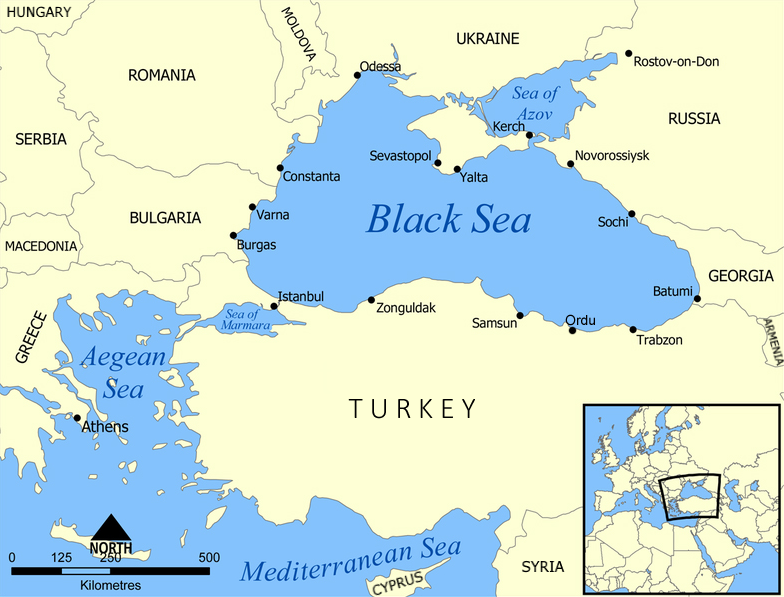
The Americans, wary of escalating an already fraught situation, cancelled the scheduled docking in Poti of the U.S. Coast Guard vessel, the Dallas, and instead sent it to the southern Georgian-controlled port of Batumi, 200km (124 miles) from the Russian ships, where it delivered humanitarian aid.

“Let’s hope we don’t see any direct confrontation,” said Dmitri Peskov, the spokesman for the Russian prime minister, Vladimir Putin, as the Russians challenged the U.S. policy of using military aircraft and ships to deliver relief supplies. "The decision to deliver aid using Nato battleships is something that hardly can be explained," said Peskov. "It's not a common practice."

He said Russian naval forces were taking "some measures of precaution" around the Black Sea as the worsening dispute caused by Russia's recognition of Abkhazia and South Ossetia independence brought strong criticism from the key European countries most reluctant to sever relations with Russia.

The German chancellor, Angela Merkel, spoke to President Dmitri Medvedev today, the first western leader to talk to the Kremlin since Medvedev announced the recognition of the two secessionist regions of Georgia. She made it plain she had voiced her strong disapproval to the Russian leader. "I made clear above all that I would have expected that we would talk about these questions in [international] organisations before unilateral recognition happened," she said. "There are several UN Security Council resolutions in which the territorial integrity of Georgia was stressed, which Russia also worked on."

The French foreign minister, Bernard Kouchner, said Russia had broken international law and, along with other senior European officials, worried that Russia's decision to redraw Georgia's borders would encourage Moscow to act similarly with other former parts of the Soviet Union such as Ukraine. "We cannot accept these violations of international law ... of a territory by the army of a neighboring country," he said.

Germany and France, who opposed the U.S. and Britain in April in blocking Georgian negotiations to join Nato, have been the most reluctant to punish Russia for the Georgian conflict of the past three weeks and are desperate to try to revive the Russia-Georgia peace plan mediated by the French president, Nicolas Sarkozy, a fortnight ago.

Paris and Berlin agree the unilateral recognition of Abkhazia and South Ossetia by Russia left the peace plan ineffectual. A summit of EU leaders in Brussels on Monday is to ponder Europe's options.

With mounting warnings of western economic or trade sanctions against Russia, an EU official admitted that threats to block Russian membership of the World Trade Organisation (WTO) were meaningless. The push for Russian admission being driven not by Moscow but by western business interests keen to tap the large Russian market, he said.

Peskov warned that trade sanctions against Moscow would hurt the west as much as Russia. He admitted that South Ossetia, a mountainous region of 70,000 people, would struggle to establish itself as an independent state, but stressed that Russia's constitution made it possible for Russia to expand. "My country will extend the arm of cooperation and friendship to ease the transition period [for South Ossetia]," he said.

EU officials complained that Moscow was seeking to control the distribution of international relief. EU aid officials were demanding entry to the Russian controlled regions, but were being barred unless they handed over the aid to the Russian authorities for distribution.

April 12, 2009

Russian-Georgian War

Russia Keeps Troops in Georgia, Defying Deal

The New York Times
April 2, 2009

Nearly eight months after the war between Russia and Georgia, Russian troops continue to hold Georgian territory that the Kremlin agreed to vacate as part of a formal cease-fire, leaving a basic condition of that agreement unfulfilled.

The Russian military, working with the governments and the small military forces of South Ossetia and Abkhazia, two separatist regions in Georgia, has stationed forces in two large swaths of territory that were under Georgian control before the war. Observers and diplomats say Russia has also used attack helicopters and stationed tanks in areas where none existed before the war.

The sustained Russian military presence on land captured last summer — evident during two recent days spent in the area by two reporters — provides a backdrop of lingering disagreement between the West and Russia at a crucial time: The Obama administration is pledging to recalibrate the relationship with Russia, restore cooperation in other areas and explore a new treaty on nuclear arms.

It also underscores the strength of Russia’s military position in the southern Caucasus and its enduring confidence in undermining President Mikheil Saakashvili of Georgia and standing up to the West, even as Mr. Obama and President Dmitri A. Medvedev of Russia have signaled an intention to improve relations. Mr. Obama and Mr. Medvedev met on Wednesday, and exchanged warm remarks and pledges to cooperate, raising questions in Tbilisi, Georgia’s capital, about whether the United States would push to have the cease-fire plan fully honored.

Under the conditions of the cease-fire, the armed forces of all sides were to return to the positions they held before the war, which erupted Aug. 7. The agreement required a cessation of fighting, corridors for aid delivery and no use of force. It also granted Russia a loosely defined permission to take further security measures while waiting for international monitors.

In the weeks after open hostilities ended, Russia did withdraw many armored and infantry units to prewar boundaries, including units posted along Georgia’s main highway and or near Georgia’s military bases.

The withdrawal eventually allowed many displaced Georgian civilians to return to villages that had been behind the Russian positions.

But even though European monitors have long been on the ground, Russia still holds large areas that had irrefutably been under Georgian control, and thousands of Georgians have not been allowed free access to homes far from the disputed territory where the war began.

Several areas under Russian control are at odds with the terms of the cease-fire plan. The most obvious examples are in the Kodori Gorge and the agricultural valley outside the town of Akhalgori — two large parcels of land dotted with Georgian villages that were partly deserted over the winter. No Russian forces were in either place before last August.

Russian armor remains in defensive positions on the road to Akhalgori, blocking access to the valley beyond. The checkpoint is jointly administered by Russia and South Ossetia, and the senior official present during a visit last week by two The New York Times journalists identified himself as a Russian Army major.

Russia also holds a fortified position and checkpoint at Perevi, and an observation post near the village of Orkhosani that overlooks Georgia’s highway.

Further, in recent months, Russia has conducted military patrols on territory it did not hold, landing helicopter-borne units just behind the boundary, according to the European Union Monitoring Mission, which was established after the war.

The Russian military also conducts aviation patrols just inside the line with helicopter gunships, the monitoring mission said, and has built a military highway through the mountains linking the Ossetian capital, Tskhinvali, with Akhalgori.

The Russian government declined multiple requests to explain the composition and roles of its forces.

Gilles Janvier, deputy head of the European monitoring mission, said in an interview that Russia had told diplomats that it had entered its own military agreement with the two breakaway regions in Georgia, which the Kremlin recognizes as independent states, and that these newer arrangements rendered the troop withdrawal component of the cease-fire plan obsolete.

“They say there is now a new bilateral agreement between them and South Ossetian and Abkhaz forces that lets them station troops,” Mr. Janvier said.

The posture has frustrated diplomats and the Georgian government alike. A senior American official said that Secretary of State Hillary Rodham Clinton raised the subject in her meeting in early March with Sergey V. Lavrov, Russia’s foreign minister, to no apparent effect.

The official also said that European leaders had been reluctant to confront Russia over the cease-fire plan. Instead, they have appeared willing to accept the cessation of open fighting and the withdrawal of Russian forces from other positions as significant steps.

“My own sense is that they were happy that the fundamentals were done, and moved on,” said the official, who spoke on condition of anonymity because the issues remain politically delicate and the position of the United States is publicly unresolved.

The Bush administration declared that Russia was not in compliance with the cease-fire. The Obama administration, which has been exploring options for cooperation with the Kremlin, has not yet taken a clear public position.

The public indecision was predictable, one independent analyst said, even though the cease-fire plan “is obviously not being fulfilled.”

“It’s business as usual,” said the analyst, Lawrence S. Sheets of the International Crisis Group. “Georgia is a country of four million people without any energy resources, and Russia is a country of 140 million people and with the ability to turn off Europe’s natural gas.”

Georgian officials have not been publicly critical of the United States. They have made clear, however, that their own ability to get Russia to comply with the agreement is essentially nonexistent.

Asked what tools were available to Georgia, Shota Utiashvili, who heads the analysis section of Georgia’s Interior Ministry, answered with a single word: “None.”

The Georgian Defense Ministry said that several thousand troops remained in the conflict area, and that Russia had a presence in at least 51 villages that it did not occupy before last summer.

The Ossetian government does not allow European monitors on its territory, and it denied access to a Times reporter seeking to cross the boundary; for these reasons, the Georgian numbers and assertions could not be independently confirmed.

With the situation at a stalemate, Irakli Alasania, who was Georgia’s ambassador to the United Nations during the war but now is in the opposition to Mr. Saakashvili, said the Russian occupation of territory beyond the old boundaries had settled into a new status quo.

The immediate question, he said, is whether the situation will get worse.

“The only thing we can do now, and the only thing we can hope for,” he said, “is to prevent another war.”

Russia warns U.S. on Georgia

Back to The Lamb Slain Home Page