Showing posts with label Israeli-Turkish Conflict. Show all posts

February 11, 2011

Israeli-Turkish Conflict

Turkey Says 5 Flotilla Victims Shot at Close Range

The Associated Press
February 11, 2011

A Turkish government inquiry into Israel's raid on a Gaza-bound flotilla that killed eight Turks and a Turkish-American says Israeli soldiers shot five victims at close range.

The report released Friday says two of the victims were killed even before soldiers boarded the Turkish ship in May. The report says Israel blatantly violated international laws.

Israeli commandos raided the flotilla as it sought to break Israel's Gaza blockade. Israel says the commandos were defending themselves.

An Israeli inquiry last month cleared its military and government of any wrongdoing, which sparked Turkish protests.

The incident further aggravated relations between the former allies, already tense over Turkish criticism of Israel's treatment of Palestinians.

Turkish Inquiry Says Israel Used Excessive Force

Turkish Inquiry Says Israel Used Excessive Force, Violated Laws In Gaza-bound Flotilla Raid

Associated Press
February 11, 2011

A Turkish committee investigating Israel's deadly raid on a Gaza-bound flotilla has refuted Israeli claims its soldiers acted in self-defense, insisting that at least two activists were killed before commandos boarded the ship, while another died "execution-style" as he lay injured.

Turkey released details of its formal inquiry into the May 31 incident Friday, hours after submitting the report to a United Nations panel investigating the incident. Eight Turkish citizens and a Turkish-American were killed when Israeli commandos boarded the Turkish ship, Mavi Marmara.

Israel has insisted its soldiers acted in self-defense after being attacked by activists on board. An Israeli inquiry into the raid last month cleared the military and government of any wrongdoing and said that the armed defense of Israel's maritime blockade of the Hamas-ruled coastal strip was justified under international law.

The Turkish inquiry report - a summary of which was released to journalists Friday - concluded that Israeli soldiers used "excessive, indiscriminate and disproportionate" force on unarmed civilians. It said the raid was a blatant violation of international laws.
"The force used was not justified, it was excessive," committee member Mithat Rende, a Foreign Ministry official, told reporters.
The report said Israeli soldiers fired live bullets from helicopters, killing two of the activists, even before they had rappelled on board. Five of the victims were killed from close range, it added.

Furkan Dogan, the 19-year-old Turkish-American, was lying wounded after being shot in the leg when he was kicked by two soldiers, who then shot him from close range "execution-style," according to the summary.

Another activist, Cevdet Kiliclar, was killed with laser-guided weapons while taking photographs, the report said.

The commando raid sparked a wave of condemnation worldwide and lead to an easing of Israel's blockade on the coastal territory. It further damaged already strained relations with Turkey, formerly one of Israel's closest allies in the region. Turkey recalled its ambassador to Israel and is demanding an apology and compensation for the victims before it says ties can return to normal.

In Jerusalem, Israeli foreign ministry spokesman Yigal Palmor said he could not comment on the Turkish findings because he had not seen the report.

Palmor said Israel had submitted its own report to the U.N. and was waiting to hear "what lessons could be learned so this doesn't happen again."

Rende said Turkish investigators questioned more than 100 "Turkish and foreign" activists on board the flotilla in compiling the report, and also sought the opinions of international legal experts.
"Israel violated laws regarding the safety of navigation in open waters and the freedom to navigate," Rende said, adding that the blockade of Gaza amounted to illegal "collective punishment" of 1.5 million people.

"Israel is responsible for the compensation of all damages and has to apologize," he said.
The report said none of the people on board had firearms and Israeli soldiers continued to fire even after activists waved white flags.
"The Israeli forces carried out a well-planned and fully equipped attack, with the use of a special combat unit, kitted with frigates, helicopters, zodiacs, submarines, automatic weapons, laser-guided weapons, and modified paintball guns," the Turkish inquiry read.
Rende said the excessive force caused panic among the activists "forcing them to use their right to self-defense, even without firearms."

In its Jan. 23 report, Israel said it was not expecting trouble and their primary weapons were paintball guns and riot control gear, but some soldiers had handguns as backup.

It said soldiers were caught offguard by the dozens of activists when they rappelled one-by-one onto the deck as the activists were waiting, wielding iron bars, clubs and knives. Some soldiers were thrown onto a lower deck and two of them were shot, apparently with weapons wrested from the Israelis and by another gun of a different caliber to that used by the army.

The report said the Israelis only opened fire when their lives were in clear and immediate danger from the activists and after they had tried other non lethal means.

Turkey, Israel Clash Again Over Flotilla Raid

A fresh row is brewing between Israel and Turkey, after the two countries released sharply conflicting findings from their separate probes into Israel’s deadly naval raid on the Gaza aid flotilla last May. - Turkey and Israel Clash Over Inquiries, Financial Times, January 23, 2011

Defense News
January 25, 2011

Rival Israeli and Turkish reports on a fatal Israeli raid on the Turkish-led aid flotilla bound for the Gaza Strip last year blame each other for the incident.

The incident on May 31 deeply strained relations between former allies Turkey and Israel. During the raid, Israeli commandos killed nine Turks.

An Israeli commission of inquiry said in a report Jan. 23 that the raid was legal under international law. The commission, headed by retired Supreme Court Judge Yaakov Turkel, ruled that Israel's continuing land, sea and air blockade of the Gaza Strip also complies with international law because Israel is effectively in a state of war with the territory's rulers, who are from the Palestinian Hamas movement.

Turkey's Prime Minister Recep Tayyip Erdogan denounced the findings.
"In my judgment there is no value or credibility to this report," he told reporters Jan. 24.
Separately, Turkey released its own report Jan. 24. The dueling reports add a new element to the diplomatic crisis that erupted between Turkey and Israel following the attack. Turkey said the report it released was an interim report and that a fresher one would be presented to the United Nations in mid-February.
"We will submit our pre-final report to the United Nations because we think the Israeli report is weak and is based merely on the views of the Israeli Supreme Court and the anonymous Israeli soldiers," said former Ambassador Özdem Sanberk, the Turkish representative on the U.N. panel tasked with investigating the flotilla attack.
The Turkish report's key finding is its allegations that two civilians were killed by Israeli commandos even before they boarded the vessel from helicopters.

Following the attack, Turkey has demanded an apology and compensation from Israel in order to repair ties. Israel has refused to do so. A U.N. commission set up to investigate the incident is expected to complete its work in February after both sides submit their final reports.

Will Gaza Flotilla Raid Mark End of Turkey-Israel Relations?

Turkey called for an international investigation into the Israeli raid on the Gaza flotilla sent to break the aid blockade. At security meeting in Istanbul today, Turkey positioned itself as a leader in crafting a regional response. Turkey-Israel relations are fraying rapidly.

Christian Science Monitor
June 7, 2010

After decades of close Turkey-Israel ties, Turkish officials today asserted that friendship can continue under only one condition: If Israel conforms with international law and human rights standards. A close, 15-year relationship between the two countries appears on the brink of collapse.

Turkey's Foreign Minister Ahmet Davutoglu said normal ties could not be restored unless Israel accepts an international investigation into the fatal raid on the Gaza aid flotilla, something it rejected last week.

Leading a summit on Eurasian security that opened Monday in Istanbul, Turkish Prime Minister Recep Tayyip Erdogan sought to take the lead in orchestrating a regional response to Israel’s raid on the “Freedom Flotilla” that tried to break the Gaza blockade. Nine Turkish citizens, one of whom had dual US citizenship, were killed in the raid, sparking widespread Turkish fury.
“If there is any so-called hate, that is the hate of the Israeli government. If there is any form of terror in the Mediterranean, this was in the state-terror organized by Israel,” Mr. Erdogan said at a joint press conference with Syrian President Bashar al-Assad. “There have been more than 100 resolutions in the [United Nations] regarding Israel, and almost none of them have been implemented by Israel…. We need to follow and pursue these resolutions to [fruition], and we are very pleased that our brother Syria is supporting us."

“There can be no open-air prisons for people. This is a crime against humanity, and there is no way this can be associated with universal values or humanitarian values,” added Erdogan. “As long as there is bloodshed and tears shed in Gaza, we cannot remain silent.”
Why Turkey is pushing the Gaza issue

Israel sees Turkey's intense pressure as a sudden, opportunistic shift designed to boost its regional standing by capitalizing on widespread Muslim anger over Israel's treatment of Palestinians, particularly in Gaza.

Israeli Foreign Minister Avigdor Lieberman this week drew a comparison to Israeli-Iranian ties, which were close in the 1970s but collapsed following the Iranian revolution. Criticism of Israel has become a vehicle for Turkey to gain regional prominence, he said.
"We were good friends for a decade, and now they are changing their policy. It's not our fault. This flotilla is just an excuse; it could be something else, '' says Tal Nahum, a spokesman for Mr. Lieberman's political party Yisrael Beitenu. "Israel is paying the price of the new Turkish policy to receive more popularity in the Muslim world.''
But Turkish leaders, bolstered by other Muslim leaders in Istanbul for the security conference, say their concern over Palestinians goes back decades. As they become convinced that the US either will not – or cannot – substantively change Israeli policies, Turkey appears to be trying to back Israel into a corner where it will be forced to change.
“Turkey is today supporting Gaza, and less than a century ago, Turkey opposed giving Palestine to the Israelis,” said Mr. Assad. “So we have had one objective through history. We have now a kind of common cause, through the blood of your martyrs and our martyrs. We have embraced the same causes, and made the same sacrifices.”
Turkey has demanded a formal apology from Israel for clashes with club- and knife-wielding activists that left nine dead when naval commandos boarded the Turkish-flagged Mavi Marmara, the flagship of flotilla. Erdogan also called for lifting the three-year blockade on all but essential goods on Gaza – a situation for the 1.5 million Palestinians in the coastal strip that Washington has called “unsustainable” – and found a ready audience.

They dropped us after a 15-year love affair'

After years of brisk commerce between Israel and Turkey – a key Muslim friend of the Jewish state – Turkey's shift to becoming a leading critic of Israeli policy has left many in Israel surprised and embittered.
"It's very painful," says Alon Liel, a former Israeli charge d'affaires in Istanbul. "There is huge frustration that they kind of dropped us after a love affair of 15 years. The Israeli public feels betrayed.''
At the end of this past week, some 2,000 Israeli demonstrators gathered outside the Turkish Embassy in Tel Aviv, setting off smoke bombs and holding up signs of Erdogan alongside Osama Bin Laden and Iranian President Mahmoud Ahmedinejad. A memorial to Turkish soldiers was vandalized twice, and a right-wing group has demanded a leading Israeli coffee maker rename its Turkish coffee.

Meanwhile, amid mass anti-Israel demonstrations by protesters in Turkey, Israel's anti-terrorism bureau warned to tourists against visiting there. Israeli Deputy Prime Minister Dan Meridor canceled a trip to Turkey at the recommendation of the Shin Bet security service, Ynet.com reported.

What's at stake

The Turkey-Israel alliance, which began to flower in the late 1990s, had symbolic, strategic, and economic significance to the Jewish state. Israel could hold up its friendship with Turkey as proof that the conflict with Arab neighbors was not about religion. Ties between the defense establishments were so close that the Israeli air force trained in the skies over Turkey and their navies held joint exercises.

But those ties began to fray after the Gaza war in 2009, which destroyed Turkish-mediated peace talks between Israel and Syria just as Turkish officials say they were about to clinch a deal. Then earlier this year, Israeli Deputy Foreign Minister Danny Ayalon humiliated Turkey's ambassador in an on-camera meeting. Pictures of Israeli commandos rappelling onto a Turkish ship were a stark contrast.

Defense contracts for Israeli equipment that once topped $750 million have slowed, though as late as last week Turkey said a $180 million deal for Israeli drones would be unaffected by the diplomatic crisis. Israeli tourism to Turkey dropped by half in 2009 from the previous year to 250,000 visitors, and trade slid to $2.5 billion from $3.5 billion, says Alon Liel, a former Israeli charge d'affaires in Istanbul.
"There's almost nothing left,'' says Mr. Liel.
Israelis have ignored the recent signs a shift in Turkish foreign policy, one that is more oriented toward positioning itself as an international proponent of Muslim interests, says Anat Lapidoth-Frilla, an expert on Israeli-Turkish ties at Hebrew University.
"Some still believe it’s a temporary,'' she said, but "we are going to continue a very stormy relationship in the near period.''
Turkey-Israel crisis: Why the formerly obscure IHH is playing a key role

June 6, 2010

Israeli Attack on Aid Flotilla in Gaza Strip


Clarification/Correction Regarding Audio Transmission Between Israeli Soldiers and Gaza-Bound Flotilla on May 31, 2010

Israeli Military Boards Gaza Aid Ship; Meets No Resistance

The New York Times
June 5, 2010

Israel prevented a new attempt to break its blockade of Gaza on Saturday when its naval commandos boarded an Irish-owned vessel carrying humanitarian supplies and prominent activists and steered it to this Israeli port.

There were no attempts at resistance or reports of violence, the Israeli military said.

The interception, 23 miles off the coast, took place less than a week after an Israeli commando raid on a Gaza-bound Turkish ship turned violent, leaving nine Turkish activists dead and creating an international crisis that severely damaged Israeli-Turkish relations.

On Friday, the Israeli and Irish governments reached an agreement to unload the vessel’s cargo in Ashdod, in southern Israel, and transport it to Gaza, but the group sponsoring both this ship and the Turkish flotilla, the Free Gaza Movement, rejected the deal.

The 11 activists and 8 crew members on board the 1,200-ton cargo ship had made clear at the outset that they would not resist and that they had no weapons. The passengers included Mairead Maguire, an Irish Nobel Peace laureate; Denis Halliday, a former United Nations assistant secretary general from Ireland; and Mohd Nizar bin Zakaria, a member of the Malaysia’s Parliament.

It was not possible to reach the boat because communications were jammed, but an Israeli journalist embedded with the navy filed an account of the takeover that confirmed the military’s report of the events.

The journalist, Ron Ben-Yishai of Ynet News, said the takeover, shortly before 12:30 p.m., took five minutes and involved two missile boats carrying about 20 combat soldiers.

A spokeswoman for the Free Gaza Movement, Greta Berlin, said by telephone from Cyprus that boarding the boat was “just another violent act,” and that “Israel needs to understand that we are not going to stop until they stop the blockade.” She said four boats were already lined up for trips to Gaza.

Her group aims to end the three-year blockade of Gaza, which Israel says is intended to prevent the infiltration of weapons and militants into the Hamas-run territory.

The Israeli military said that the ship, the Rachel Corrie, had been asked three times to dock in Ashdod, change course or face a naval takeover and that the requests had been ignored. The operation did not involve an airdrop as in the raid on Monday.

A military spokeswoman here, Lt. Col. Avital Leibovich, said the passengers would be questioned by the police, processed through customs and deported. Those who refused deportation could face jail, she said.

A senior naval commander said that the cargo would be inspected here and that anything that would not serve Hamas for weapons or defense would be sent over land to Gaza.

The commander, who spoke by telephone to journalists under military rules of anonymity, was asked why Israel did not agree to inspect the cargo at sea and then permit the boat to reach Gaza.
“It is not possible to inspect thousands of bags inside a vessel,” he said. “You have to unload it in port and examine it there.”
He said the entire cargo would be delivered to Gaza, including cement, which is usually banned. Israel says cement can be used to build bunkers, tunnels and rockets. However, some shipments have recently been allowed for specific civilian building projects.

Israel has been widely condemned for its blockade, which some experts in international law say is illegal. After Monday’s raid, when Israeli commandos met fierce resistance and opened fire on the anti-blockade activists, Israel said it was open to new ways to ensure that civilian goods could enter Gaza while meeting Israeli security needs. It is unclear what the new ways would include.

At the United Nations, Secretary General Ban Ki-moon was cobbling together a proposal for an international panel to investigate the deadly raid.

The panel would include representatives from Turkey and Israel, or at least one member each to represent their interests, and two or three others selected from a list assembled by Mr. Ban, diplomats said.

Mr. Ban plans to pitch the plan to Israel and Turkey over the weekend, the diplomats said, and the United States has said it will sign off on it once Israel accepts it.

There was no immediate reaction from the missions of Israel or Turkey.

Turkey, with Arab support, has been adamant that the Security Council statement on the raid approved by all 15 members on Tuesday meant that an investigation by Israel alone would be insufficient. The Council’s statement said the investigation should be impartial, transparent and credible, but did not explicitly say international.

While Israel has resisted the idea of an international investigation, insisting it is perfectly capable of carrying out an investigation on its own, Israeli cabinet members have indicated it might accept some foreign participation.

The United States has suggested that some international representation on the panel would make the results more credible, as it did on the panel recently convened by South Korea to investigate the sinking of its warship.

The Rachel Corrie, named after an American activist killed in 2003 as she tried to prevent an Israeli bulldozer from razing a Palestinian home, had been due to join the other boats in the flotilla last week but was delayed by technical problems.

Hamas, which rejects Israel’s existence, won Palestinian parliamentary elections in early 2006. Israel then began to reduce trade and relations with Gaza. When Hamas militants seized an Israeli soldier, Gilad Shalit, in a raid that June, Israel further reduced what was permitted in and out of the coastal territory.

A year later, after Hamas fighters drove the more moderate Fatah movement from Gaza, Israel imposed a full closing on Gaza, permitting in only basic humanitarian goods.

Although international aid agencies say there is no starvation or acute medical crisis there, malnutrition is creeping up, water treatment and sewage are problematic and the economy has been almost entirely shut down by the blockade, which is also enforced by Egypt. The United States and other world powers say that the situation is untenable and that a new approach must be found.

In Gaza: What is Not Allowed

By Richard Tillinghast, The Irish Times
June 6, 2010

No tinned meat is allowed, no tomato paste,
no clothing, no shoes, no notebooks.
These will be stored in our warehouses at Kerem Shalom
until further notice.
Bananas, apples, and persimmons are allowed into Gaza,
peaches and dates, and now macaroni
(after the American Senator’s visit).
These are vital for daily sustenance.

But no apricots, no plums, no grapes, no avocados, no jam.
These are luxuries and are not allowed.
Paper for textbooks is not allowed.
The terrorists could use it to print seditious material.
And why do you need textbooks
now that your schools are rubble?
No steel is allowed, no building supplies, no plastic pipe.
These the terrorists could use to launch rockets
against us.

Pumpkins and carrots you may have, but no delicacies,
no cherries, no pomegranates, no watermelon, no onions,
no chocolate.

We have a list of three dozen items that are allowed,
but we are not obliged to disclose its contents.
This is the decision arrived at
by Colonel Levi, Colonel Rosenzweig, and Colonel Segal.

Our motto:
‘No prosperity, no development, no humanitarian crisis.’
You may fish in the Mediterranean,
but only as far as three km from shore.
Beyond that and we open fire.
It is a great pity the waters are polluted
twenty million gallons of raw sewage dumped into the sea every day
is the figure given.

Our rockets struck the sewage treatments plants,
and at this point spare parts to repair them are not allowed.
As long as Hamas threatens us,
no cement is allowed, no glass, no medical equipment.
We are watching you from our pilotless drones
as you cook your sparse meals over open fires
and bed down
in the ruins of houses destroyed by tank shells.

And if your children can’t sleep,
missing the ones who were killed in our incursion,
or cry out in the night, or wet their beds
in your makeshift refugee tents,
or scream, feeling pain in their amputated limbs –
that’s the price you pay for harbouring terrorists.

God gave us this land.
A land without a people for a people without a land.

June 5, 2010

Israeli Attack on Aid Flotilla in Gaza Strip

Portland, Maine Video Producer Recounts Gaza Flotilla Ordeal

The Associated Press
June 5, 2010

A Maine video producer recalled hearing shots amid the chaos that broke out as Israeli troops raided the aid flotilla he was on that was attempting to break Israel's blockade of Gaza.

Scott Hamann of South Portland arrived in Maine late Friday night, five days after the flotilla was intercepted by Israeli troops, resulting in the deaths of nine pro-Palestinian activists.

In a phone interview with The Associated Press, Hamann said troops that landed on the boat he was on fired high-powered paintball guns and threw a "stun grenade" that hit him on the foot before exploding behind him.

People aboard the flotilla expected a confrontation, but not a deadly one, he said.
"As soon as we heard the real guns going off, that's when we knew things were different than what we thought they'd be," he said. "We knew they'd use excessive force, but it was a game changer when we heard they were shooting people."
The six-ship flotilla was attempting to deliver supplies to Gaza in defiance of a 3-year-old Israeli blockade that has aimed to prevent the smuggling of weapons into Gaza that could be used to attack Israel. At the same time, it has deepened the poverty of the 1.5 million Palestinians in the strip and heightened Mideast tensions.

The flotilla's journey ended when Israeli commandos boarded the vessels early Monday morning and clashed with passengers on one ship in a confrontation that left nine people dead.

Israel says troops used force only after they were attacked with weapons. Activists say Israel fired first.

Hamann, 29, owns Harbor Light Films video production company in South Portland. He was documenting the event as a job but also felt strongly about the cause.

David Rubinson, a former music producer in the U.S. who now lives in Eze, France, said he hired Hamann to ride aboard one of the six vessels in the flotilla, shoot video and photographs and post them on the website.

Hamann said the flotilla was in international waters when it was intercepted by Israeli troops. When they boarded his vessel, Challenger I, they destroyed all video footage and camera memory cards, he said.

He and hundreds of others on the flotilla were then brought to an Israeli prison and detained before they were deported.

There, Israeli troops and intelligence officers intimidated and threatened the prisoners, he said. After being brought to an airport to be put on a plane, two deportees were attacked by soldiers when they refused to sign deportation orders, he said.

One of them, he said, was an American citizen who was beaten and bloodied. When soldiers gave him water to wash his face, he refused to do so, saying he wanted people to see what they did to him, Hamann said.
"Then they beat him up really bad and we haven't seen him since. The status, the last I heard, isn't good," he said.
Speaking from France earlier this week, Rubinson said little media attention was paid to another aid flotilla last year that was disrupted by Israel as it made its way to Gaza. This time, he wanted to make sure people worldwide could witness the journey through video and photographs posted on the website.

Rubinson is Jewish, but no longer practices his faith because of his disapproval of Israel's actions against Gaza.
"I'm doing this because it's my people who are perpetrating this tragedy," he said. "I feel it is imperative we do something to stop it."

June 1, 2010

Israeli Attack on Aid Flotilla in Gaza Strip


Israel: The Pariah of the International Community

Pravda.Ru
May 31, 2010

The most striking feature about Israel’s most recent act of terrorism, an act of piracy and murder on the high seas, is that it surprises nobody. A robber steals. Israel commits war crimes. What is even more remarkable is its attempts at self-justification, claiming that its soldiers were attacked.

Well of course they were attacked. They were illegally boarding a ship carrying peace activists trying to feed the starving people of Gaza in international waters. This was an act of piracy, this was an act of terrorism. Someone invades your space. You fight back.

A Synopsis of Zionism and the Israel/Palestine Conflict Historic Palestine

For thousands of years there was no conflict in Palestine. In the 19th century, the land of Palestine was inhabited by a multicultural population of Palestinian Arabs — approximately 86 percent Muslim, 10 percent Christian, and 4 percent Jewish. For centuries these groups lived in harmony.

In the late 1800s, a group in Europe decided to colonize this land. Known as "Zionists," this group consisted of an extremist minority of the Jewish population who wanted to create a Jewish homeland. They considered locations in Africa and the Americas before settling on Palestine, where the Jewish State of Israel was established in 1948.

Largely due to one-sided special-interest lobbying by AIPAC, the U.S. has given more funds to Israel than to any other nation: $85 billion in grants, loans and commodities since 1949, with an additional $50 billion in interest costs for advance payments, for a total cost of $135 billion or $23,240 per Israeli. During fiscal year 2007, the U.S. gave an average of $7 million per day to the State of Israel.

Palestinian Loss of Land 1946-2005


Jews Against Zionism
"Although there are those who refuse to accept the teachings of our rabbis and will continue to support the Zionist state, there are also many who are totally unaware of the history of Zionism and its contradiction to the beliefs of Torah-True Jews. From its inception, many rabbis warned of the potential dangers of Zionism and openly declared that all Jews loyal to G-d should stay away from it like one would from fire. They made their opinions clear to their congregants and to the general public. Their message was that Zionism is a chauvinistic racist phenomenon which has absolutely naught to do with Judaism. They publicly expressed that Zionism would definitely be detrimental to the well being of Jews and Gentiles and that its effects on the Jewish religion would be nothing other than destructive. Further, it would taint the reputation of Jewry as a whole and would cause utter confusion in the Jewish and non-Jewish communities. Judaism is a religion. Judaism is not a race or a nationality. That was and still remains the consensus amongst the rabbis."

"We were given the Holy Land by G-d in order to be able to study and practice the Torah without disturbance and to attain levels of holiness difficult to attain outside of the Holy Land. We abused the privilege and we were expelled. That is exactly what all Jews say in their prayers on every Jewish festival, 'Umipnay chatoenu golinu mayartsaynu'-'Because of our sins, we were expelled from our land.'"

"We have been forsworn by G-d 'not to enter the Holy Land as a body before the predestined time;' 'not to rebel against the nations;' to be loyal citizens, not to do anything against the will of any nation or its honour; not to seek vengeance, discord, restitution or compensation; 'not to leave exile ahead of time.' On the contrary, we have to be humble and accept the yoke of exile. To violate the oaths would result in 'your flesh will be made prey as the deer and the antelope in the forest,' and the redemption will be delayed."

What Israel has to understand is that to be accepted as a member of the international community, it has to act like one and this involves abiding by UN Resolutions, it means not only halting the building of colonies on land which has been stolen from Palestinians, it involves dismantling each and every colony set up on land outside the original borders of Israel.

The theft of identities to carry out a mafia-style hit, violations of human rights, the bulldozing of civilian homes, the seizure of land, attacking ambulances and shooting rescue workers, the shooting of children in the eyes with rubber bullets, the wearing of T-shirts with pregnant women with the caption “Two for the price of one” or “Two with one bullet” may be funny to Israeli people, it may even be hilarious and no doubt has many of them curled up giggling themselves helplessly to a doubled laundry bill.

True, there are many Israelis who are not Zionists. True, there are many Israelis who support Palestinian causes and inspect the actions of the Israeli Defense Force. True, not all Jews support the murderous horrific and illegal practices of the State of Israel. Yet the State of Israel goes on and on and on…and on, perpetrating them.

And what precisely does Israel hope to gain from these outrages against international law? Friendship? Sympathy? Respect? If so, then the notion that Israelis are intelligent, if one may hazard a collective description, is blasted into outer space. Such actions drive a wedge further between the hearts and minds of those of us who wish to live together like brothers and sisters around a common lake – our seas – and those who seem to like to live and die by the sword.

The notion that Israel can get off scot-free after this latest act of terrorism is as unacceptable as it is true. Ladies and gentlemen, it is going to happen. Watch this space. Israel’s main colony, the United States of America (ruled in fact by AIPAC) will veto any attempt at sanctions through the United Nations. Turkey will not pull off a punitive raid. After all, Israelis are not defenceless Armenians.

Israel will not shift an inch. It will go on bulldozing homes, it will go on stealing land, it will go on shooting kids in the eye with rubber bullets, it will go on letting pregnant mothers die in the streets, it will go on carrying out acts of terrorism and it will go on committing slaughters. International diplomacy will do nothing because the United States of America is held in a vice-like grip around its throat (or wherever) by Tel Aviv.

The way forward is not diplomacy as it stands today because diplomacy and international law do not exist where Israel is concerned. Let’s be honest about it. The way forward is also not violence and terrorism because it is fundamentally wrong, goes against every grain of common human decency and anyway engenders only more violence in an escalating spiral. No, the way forward is through economic measures. This approach is totally legal, non-violent and effective.

The only thing that the international community can do, is act with its feet. Or rather, with its wallet, boycotting Israeli goods. Anything with the serial number 729 (first three numbers on the left of a bar code) comes from Israel.

Israeli Attack on Aid Flotilla in Gaza Strip

Activists Send New Boat to Challenge Gaza Blockade

Associated Press
June 1, 2010

Pro-Palestinian activists sent another boat to challenge Israel's blockade of the Gaza Strip on Tuesday, and Egypt declared it was temporarily opening a crossing into the Palestinian territory after a raid on an aid flotilla that ended with Israeli soldiers killing nine activists.

The raid provoked ferocious international condemnation of Israel, raised questions at home, and appeared likely to increase pressure to end its blockade that seeks to keep Iranian-backed Hamas from building its arsenal of weapons but has also deepened the poverty of the 1.5 million Palestinians in the strip.

Turkey, which unofficially supported the flotilla, has led the criticism, calling the Israeli raid a "bloody massacre" and demanding that Washington condemn the raid. The White House has reacted cautiously, calling for disclosure of all the facts.

There were signs, however, that the long-term strategic partnership between Israel and its most important Muslim ally would endure: Turkey canceled three joint land and sea exercises, but appeared to be otherwise maintaining deep military ties that include the planned delivery of $183 million in Israeli drones this summer.

Israeli Defense Minister Ehud Barak spoke to his Turkish counterpart as well as their chief of staff Monday, and they agreed that the raid wouldn't affect weapons deals, defense officials said. The officials spoke on condition of anonymity because they were discussing sensitive military ties.

Israeli Prime Minister Benjamin Netanyahu's spokesman, Mark Regev, indicated Israel would consider ways to ease the blockade to allow more goods into Gaza — a policy that has been quietly under way in recent months.

"We have been expanding the assistance that has been going into the Gaza Strip — both the volume and the variety of goods — and we have ongoing dialogue with the international community.
But he stressed that Israel could not end the blockade, fearing that Hamas would ship rockets and other weapons into the area.
"We cannot have unfettered naval cargo going into the Gaza Strip," he said.
Amid the tensions, the Israeli military said it carried out an airstrike in Gaza on Tuesday, and an Islamic militant group said three of its members were killed after firing rockets into southern Israel. Israeli authorities say the rockets landed in open areas and caused no injuries.

Two militants infiltrating into Israel from Gaza were killed in a separate incident Tuesday, the military said.

In other violence, Israeli hospital officials said an American woman lost her eye during a demonstration Monday in Jerusalem against the naval raid. Emily Henochowicz of Maryland was in intensive care after undergoing surgery, said hospital spokeswoman Yael Bossem-Levy. Witnesses said Henochowicz, 21, was hit by a tear gas canister in the face while Palestinian youths were throwing rocks, although she was standing at a distance.

The pro-Palestinian flotilla had been headed to Gaza with tens of thousands of tons of aid that Israel bans from Gaza. After days of warnings, Israel intercepted the flotilla under the cover of darkness early Monday, setting off a violent melee that left nine activists dead and dozens of people, including seven soldiers, wounded. Most of the dead were believed to be Turks.

Israel said 679 people were arrested, and about 50 of those had left the country voluntarily. Hundreds who refused to cooperate remained jailed and subject to deportation.

Israel says the Gaza blockade is needed to prevent Hamas, which has fired thousands of rockets into the Jewish state, from building up its arsenal. It also wants to pressure Hamas to free an Israeli soldier it has held for four years.

Critics say the blockade has failed to weaken Hamas but further strapped an already impoverished economy. It also has prevented Gaza from rebuilding after a devastating Israeli military offensive early last year.

Egypt, which has enforced the blockade with Israel since Hamas militants seized control of Gaza in 2007, said it was opening the border for several days to allow aid into the area as a humanitarian gesture. It was unclear, however, when Hamas guards at the frontier would let people out.

Several thousand Gazans — some in cars with suitcases piled on their roofs, others on foot — rushed to the Egyptian border, hoping to take advantage of a rare chance to escape the blockaded territory.

The Hamas Interior Ministry said authorities were not prepared to open the crossing and noted that government employees were on strike to mourn those killed in Monday's raid. Large crowds of people milled about the crossing, occasionally shouting at border guards, but there was no unrest.

Dozens of Hamas police with automatic weapons patrolled the area to maintain order.
"We are working to help residents take advantage of this opportunity," said Hamas Interior Ministry spokesman Ihab Ghussein. "We hope it will be open all the time, not just as a response to yesterday's events."
Greta Berlin said the Free Gaza Movement, which organized the flotilla, would not be deterred and that another cargo boat was off the coast of Italy en route to Gaza. A second boat carrying about three dozen passengers is expected to join it, Berlin said. She said the two boats would arrive in the region late this week or early next week.
"This initiative is not going to stop," she said from the group's base in Cyprus. "We think eventually Israel will get some kind of common sense. They're going to have to stop the blockade of Gaza, and one of the ways to do this is for us to continue to send the boats."
The Israeli military refused to say how it would respond to the arrival of new Gaza-bound ships. But Israeli Foreign Ministry spokesman Yigal Palmor said, "there is no change in policy" and urged activists to send the aid into Gaza through current, authorized means.
"We have no intention to use violence and there is no need for this to end violently," Palmor said. "If they want the aid to get to Gaza, they can send through the regular peaceful channels. I think they understand that seeking confrontation will not do them any good."
Protests erupted in a number of Muslim countries, including Turkey, which unofficially supported the flotilla, Indonesia and Malaysia, where a Palestinian man slashed himself outside the U.S. Embassy.

Prime Minister Recep Tayyip Erdogan, an outspoken critic of Israel, told lawmakers the Israeli raid was an attack "on international law, the conscience of humanity and world peace."
"This bloody massacre by Israel on ships that were taking humanitarian aid to Gaza deserves every kind of curse," he said, demanding that Israel immediately halt its "inhumane" blockade of Gaza.
Thousands of pro-Islamic and nationalist Turks have poured into the streets in Istanbul and Ankara since the report of the Israeli raid. Protesters with Palestinian and Turkish flags shouted "Down with Israel!" outside Israeli diplomatic missions.

Turkey's Foreign Ministry said four Turkish citizens were confirmed slain by Israeli commandos and another five were also believed to be Turks. Israeli authorities were still trying to confirm their nationalities.

Within Israel, the raid sparked intense debate over why the military operation went awry.

Israel sent commandos onto the six ships carrying nearly 700 activists after mission organizers ignored the government's call to bring the cargo to an Israeli port, where it would be inspected and transferred to Gaza. In most cases, the passengers quickly surrendered. But on the largest ship, the Turkish-flagged Mavi Marmara, the forces encountered resistance.

Israeli commandos rappelled on ropes from a helicopter and army videos showed them being attacked by angry activists with metal rods and one soldier being thrown off the ship. Others jumped overboard to escape the angry mob. Israeli authorities said they were attacked by knives, clubs and live fire from two pistols wrested from soldiers. The soldiers then opened fire, killing nine.

Israeli military analysts said it was a mistake to send commandos to board the Marmara and the military could have used non-lethal weapons such as tear gas. They also said the intelligence-gathering was faulty.

Retired Gen. Shlomo Brom asked why the ships' engines weren't sabotaged instead.
"There were certain objectives to this operation. One was not to let the vessels get to Gaza, but the other objective was to do it without any damage to Israel's image," Brom told The Associated Press. "Certainly it failed."
The daily Maariv, in a front-page headline, called the raid a "debacle."

Sabine Haddad, spokeswoman for the Israeli Interior Ministry, said 679 people were arrested and handed deportation orders. By midafternoon Tuesday, some 50 people had left the country voluntarily. But hundreds refused to cooperate and were jailed.
"The rest said they wanted to go to jail and are at Beersheba jail going through a process of deportation," she said.
She said judges were hearing the cases and that almost everyone would be expelled within the next few days.

She said more than half of those arrested were from Turkey, with others coming from more than 30 other countries, including Britain, Algeria, Jordan, Kuwait, Germany and the U.S. Israeli police said four Arab Israeli citizens would face criminal charges.

Israel did not allow access to the activists, but a handful who were deported arrived home Tuesday, including a Turkish woman and her 1-year-old son, six Greeks and three German lawmakers.
"There was a massacre on board," said the woman, Nilufer Cetin, whose husband, Ekrem, is the Marmara's engineer and was still in Israeli custody. "The ship turned into a lake of blood."
Norman Paech, a former member of Germany's Left Party who was aboard the Marmara, said he only saw three activists resisting.
"They had no knives, no axes, only sticks that they used to defend themselves," Paech said at a news conference in Berlin after he and four other Germans returned from Tel Aviv. He added, however, that he could "not rule out" that others used weapons somewhere else on the boat.
Turkey said it was sending three ambulance planes to Israel to return 20 Turkish activists injured in the operation and had other aircraft ready to get other activists. About 400 Turks took part in the flotilla.

The flotilla was the ninth attempt by sea to breach the blockade Israel and Egypt imposed after Hamas violently seized the territory. Israel allowed five seaborne aid shipments through but snapped the blockade shut after its 2009 war in Gaza.

There was little call in Israel to end the blockade. Israelis have little sympathy for Gaza, which sent thousands of rockets and mortar rounds crashing into Israel for years before last year's war.

The Israeli-Gaza border was tense following the naval raid.

The Iranian-backed Islamic Jihad said three of its fighters were killed Tuesday shortly after firing rockets into southern Israel. Israeli authorities say the rockets landed in open areas and caused no injuries.

The Israeli military confirmed its airstrike, and Gaza's chief medical examiner also said there were three deaths.

On Tuesday morning, the Israeli military said Gaza militants infiltrated Israel and exchanged fire with troops. Israeli rescue services said two militants were killed, but the military would not immediately confirm that.

May 31, 2010

Israeli Attack on Aid Flotilla in Gaza Strip

Israeli Commandos Attack Gaza Relief Fleet: 10 Reported Killed (Video)

theage.com.au
May 31, 2010

Ten people were reported killed and about 30 wounded as Israeli forces stormed a Turkish ship in the flotilla carrying aid to the Gaza Strip, according to Turkish and Israeli media.

Israeli private channel 10 television reported that Israeli marine commandos had opened fire after being attacked with axes and knives by a number of the passengers on board the aid ships. It did not give the source of its information.

The station did not say whether the dead and injured were passengers or members of the Israeli navy.

Israel's army radio said between 10 and 14 people had been killed in clashes which broke out after the passengers allegedly tried to grab weapons off the naval commandos who tried to storm one of the boats.

It was not clear whether the clashes were taking place on just one of the six boats making up the aid convoy, and the Israeli army had no immediate comment on the incident.

Shortly afterwards, the Israeli military censor ordered a block on all information regarding those injured or killed during the storming of the ship.

Serkan Nergis from the Foundation of Humanitarian Relief (IHH), an Istanbul-based Islamist charity, earlier told AFP by telephone: "Our friends on the ship told us that two people were killed and around 30 others were wounded on the Mavi Marmara ship."

Hamas-run Al-Aqsa television showed footage of black-clad Israeli commandos descending from helicopters and clashing with activists, as well as several wounded people lying on the deck of the ship.

Turkish television station NTV reported at least 10 people were killed, according to Israeli news website Haaretz.com.

The Israeli military declined to comment on the reports and organisers of the aid convoy said they were no longer in contact with the boats.

Israeli Defence Force radio was reporting passengers on board the aid-laden convoy of boats tried to wrest weapons from Israeli soldiers, according to the Jerusalem Post.

Army radio was reporting the passengers’ actions - grabbing weapons out of the soldiers’ arms - started the violence.

The Free Gaza organisation said on Twitter their lawyer in the Israeli city of Haifa said 10 people had been killed.

The group said the boats were being taken into Haifa by the Israeli Defence Force (IDF).

An hour-and-a-half earlier the group announced IDF commandos had boarded the boats from helicopters.
‘‘At about 4:30 am (local time), Israeli commandos dropped from helicopter onto deck of Turkish ship, immediately opened fire on unarmed civilians,’’ the group wrote.

‘‘Israeli soldiers shooting at people, all over the Turkish boat,’’ they said about half an hour later.
The Israeli ambassador was summoned to the Turkish foreign ministry today after a Turkish aid ship was stormed, a Turkish diplomat said.
"The ambassador (Gabby Levy) was summoned to the foreign ministry. We will convey our reaction in the strongest terms," the diplomat, who asked not to be named, told AFP.
Meanwhile in Turkey, local media is reporting police have blocked dozens of stone-throwing protesters who tried to storm the Israeli Consulate in Istanbul following the flotilla attack.

CNN-Turk and NTV televisions show dozens of angry protesters scuffling with Turkish police, who are guarding the Consulate in downtown Istanbul.

The protesters were shouting ‘‘damn Israel’’, according to the Associated Press.

The ships, carrying more than 700 passengers, were on the last leg of a high-profile mission to deliver some 10,000 tonnes of building and other supplies to Gaza, which has been under a crippling Israeli blockade since 2007.

Huwaida Arraf, chairman of the Free Gaza Movement, had earlier told AFP by phone from the boat Challenger 1 that the ships had expected a confrontation with Israel today.

The boats had started heading towards Gaza from international waters of Cyprus at 3pm local time (1200 GMT) Sunday, with organisers saying they hoped to enter Gaza waters during the daylight hours.

About six hours after their departure, three Israeli missile boats left their naval base in the northern coastal city of Haifa on a mission to intercept the flotilla, reporters on board one of the vessels said before being told to turn off their phones.

Israel has slammed as "illegal" the convoy's attempt to break the Gaza blockade and warned it would intercept the ships, tow them to the Ashdod port and detain the activists before seeking to deport them.

In Gaza, anti-siege activists on Sunday called on the international community to ensure the protection of the "Freedom Flotilla" which had been aiming to arrive on Saturday but was repeatedly delayed.
"I am asking the international community to protect these boats from the Israeli threat," independent Palestinian MP Jamal al-Khudari told a news conference on a boat anchored outside the Gaza port.

"If Israel blocks them, they have a strategy for getting here," said Khudari, who heads the Gaza-based Committee to Lift the Siege. He did not elaborate.
With the flotilla expected to approach at some stage over the next 24 hours, Gaza fishermen took to the sea flying Palestinian flags as well as those of Greece, Ireland, Sweden and Turkey -- all of which sent boats.

Demonstrators also released scores of balloons with pictures tied to them of children killed during Israel's massive 22-day offensive against Gaza that ended in January 2009.

Khudari said the convoy, which is carrying hundreds of civilians and a handful of European MPs, would stop outside Gaza territorial waters before attempting to make landfall.

It will travel "in two stages," he said: "First they will stop in international waters at 30 nautical miles (from Gaza), and tomorrow (Monday) they will reach the shore."

Audrey Bomse, legal adviser to the Free Gaza Movement, said the activists were considering sending "a second wave" of boats later this week.

Israel has called the convoy a media stunt, insisting the humanitarian situation is stable in Gaza despite reports to the contrary from aid agencies and offering to deliver the supplies through its own land crossings.
"This is a provocation intended to delegitimise Israel," Deputy Foreign Minister Danny Ayalon said on Saturday.

"If the flotilla had a genuine humanitarian goal, then its organisers should have transferred something for the abducted soldier Gilad Shalit as well," he said of the Israeli snatched by militants in 2006 and held by the Hamas Islamist movement which runs the enclave.
The activists responded on their website that they had offered to take in a letter for Shalit from his family but received no response from their lawyer.

Hamas's refusal to release Shalit is cited by Israel as one of the main reasons for imposing the economic blockade on Gaza in the wake of the group's violent takeover of the territory.

Pro-Palestinian activists have landed in Gaza five times, with another three unsuccessful attempts since their first such voyage in August 2008. The latest is their biggest operation.


Israel in Eye of Storm Over Gaza Raid

AFP
May 31, 2010

Israel's allies froze military ties and summoned ambassadors on Monday over the storming of an aid flotilla bound for Gaza, as Muslim leaders slammed the deadly raid as "criminal" and "inhuman".

UN Secretary General Ban Ki-moon said he was "shocked" by the deadly Israeli assault on a convoy carrying hundreds of pro-Palestinian activists, lawmakers and journalists through international waters towards besieged Gaza.
"It is vital that there is a full investigation to determine exactly how this bloodshed took place," Ban said, calling on Israel to "urgently" explain itself over the raid, which left up to 19 dead, many of them reportedly Turks.
As the Vatican voiced "deep sadness and concern" at the loss of life, capitals across Europe summoned Israel's ambassadors to explain the assault.

Ankara responded with fury, recalling its ambassador from Tel Aviv and warning the assault would have "irreparable consequences" to bilateral ties.

Police held back angry crowds shouting "Damn Israel" outside Israel's missions to the country, as Turkey accused Israel of a "fragrant breach of international law," and "disregard for human life and peaceful initiatives."

Deputy Prime Minister Bulent Arinc also said plans for three joint military exercises with Israel had been scrapped.

Greece, which had dozens of nationals in the convoy, pulled out of joint military exercises with Israel and cancelled a visit by its air force chief, as an aid group claimed that commandos in helicopters had fired on a Greek vessel.

Two Australians are in an Israeli detention centre after they were caught up in the deadly clash.

Fairfax journalist Paul McGeough and photographer Kate Geraghty were travelling with the flotilla.

They are reported to be safe.

Israel said its naval forces were attacked after they stormed six ships loaded with thousands of tonnes of aid and with hundreds of activists aboard, and that both sides used live fire.

But Iran's President Mahmoud Ahmadinejad denounced the raid as "inhuman Zionist regime action," while the Islamist movement Hamas which rules Gaza urged world Muslims to "rise up" in protest.

Palestinian president Mahmud Abbas declared three days of mourning over the "massacre," while Arab League chief Amr Mussa called it a "crime."

Lebanese Prime Minister Saad Hariri called for an emergency meeting of the UN Security Council, which his country currently chairs, a government official said.

Egypt condemned the "acts of killing committed by Israel forces" while Kuwait's parliament speaker said the storming of the flotilla, which was carrying 16 Kuwaitis including an MP, was a "heinous Israeli crime."

In Europe, condemnation was equally swift.

The European Union foreign affairs chief Catherine Ashton demanded Israel mount a "full inquiry," as member states ordered an emergency meeting of their ambassadors to the EU in Brussels on Monday.

Spain - the current European Union president - France, Sweden, Norway, Denmark, Austria and Greece summoned Israel's ambassadors for explanations, with Madrid slamming the operation as "unacceptable".

France's President Nicolas Sarkozy accused Israel of a "disproportionate use of force" while Foreign Minister Bernard Kouchner insisted "nothing can justify" such violence.

Germany's Foreign Minister Guido Westerwelle also said he was "deeply concerned" about the deaths, while Italy's Foreign Minister Franco Frattini "deplored" the loss of civilian life.

Israel's Channel 10 TV said 19 passengers were killed and 36 wounded in the raid.

The bloody ending to the high-profile mission to deliver supplies to Gaza came on the eve of a meeting in Washington between US President Barack Obama and Israeli Prime Minister Benjamin Netanyahu.

Thousands of Palestinian refugees and activists demonstrated across Lebanon to denounce the raid, some chanting slogans like "Give us weapons, give us weapons and send us on to Gaza".

Maen Bashur, a Lebanese coordinator for the mission, said activists had expected the convoy to be "attacked" by the Israelis and considered those seized on board the ship as "war prisoners".

A Cyprus MEP Kyriacos Triantafyllides, who was prevented at the last minute from joining the aid mission, told the Cypriot news agency CNA that activists had "expected a strong reaction from Israel."
"But nobody believed it would come to this point where they would face something akin to an invading army," he said.


Israeli Commandos Storm Aid Flotilla; 10 Killed

NBC, msnbc.com and news services
May 31, 2010

Israeli commandos on Monday stormed six ships carrying hundreds of pro-Palestinian activists on an aid mission to the blockaded Gaza Strip, killing at least 10 people and wounding dozens.

The operation in international waters off the Gaza coast was a nightmare scenario for Israel that looked certain to further damage its international standing, strain already tense relations with Turkey and draw unwanted attention to Gaza's plight.

The two sides offered conflicting accounts of what happened.

A reporter on one of the boats said the Israelis fired at the vessel before boarding it. Israeli officials said the soldiers were attacked with knives, clubs and iron bars as they boarded the six vessels. The Israeli military said the violence turned deadly after one of the activists grabbed a weapon from one of the commandos. The weapon discharged, though it wasn't clear whether the activist fired it or if it went off accidentally.

"Our initial findings show that at least 10 convoy participants were killed," an Israeli military spokesman said, adding that at least four soldiers were wounded.
Israeli Defense Minister Ehud Barak expressed regret for the deaths. However, he called the aid flotilla a "political provocation" by anti-Israel forces. Barak said the sponsors of the flotilla are violent.

However, U.N. Secretary-General Ban Ki-moon expressed shock over the incident and called on Israel to "urgently provide a full explanation."

Nobel laureate

Some 700 pro-Palestinian activists were on the boats, including 1976 Nobel Peace Prize laureate Mairead Corrigan Maguire of Northern Ireland, European legislators and an elderly Holocaust survivor.

NBC News reported that 11 Americans were among the civilians aboard the ships. They include a former ambassador and a former State Department official.

"The United States deeply regrets the loss of life and injuries sustained, and is currently working to understand the circumstances surrounding this tragedy," White House spokesman Bill Burton told reporters.
Al-Jazeera TV reported by telephone from the Turkish ship leading the flotilla that Israeli forces fired at the ship and boarded it, wounding the captain. The broadcast ended with a voice shouting in Hebrew, "Everybody shut up!"

Turkey's NTV network reported that dozens of activists were wounded. France24 television aired video of a woman in a Muslim headdress holding a stretcher with a large bloodstain on it. Below her lay a man, apparently injured, in a blanket.

Palestinian President Mahmoud Abbas described the incident as a "massacre," the official Wafa news agency reported.

Abbas, whose Fatah faction lost control of the Gaza Strip in fighting with Hamas in 2007, declared three days of mourning in the Palestinian territories.

Israeli security forces were on alert across the country.

The tough Israeli response drew condemnations from Turkey, France and the U.N.'s Mideast envoy, while Greece suspended a military exercise with Israel and postponed a visit by Israel's air force chief. The European Union called for an investigation into the incident and urged Israel to allow the free flow of humanitarian aid to the Gaza Strip.

About 10,000 Turks also marched from Israel's Consulate in Istanbul toward the city's main square, shouting slogans denouncing Israel. The protesters earlier Monday tried storm the Consulate building but were blocked by police.

In response, Israel advised its citizens Monday to avoid travel to Turkey and instructed those already there to keep a low profile.

In neighboring Jordan, hundreds demonstrated in the capital Amman to protest the Israeli action and demand that their government breaks diplomatic relations with the Jewish state.

Danny Ayalon, Israel's deputy foreign minister, told a news conference that weapons had been found aboard the vessels and described the flotilla as an "armada of hate and violence."

The activists were headed to Gaza on a mission meant to draw attention to a three-year-old Israeli blockade of the coastal territory. Israel imposed the blockade after Hamas militants took power there.

Pandemonium

Israel had declared it would not allow the ships to reach Gaza and had offered to transfer the aid to Gaza from an Israeli port. Israeli naval commandos raided the ships while they were in international waters after ordering them to stop about 80 miles from Gaza's coast, according to a pro-Palestinian activist in Greece involved in the aid mission.

A Turkish website showed video of pandemonium on board one of the ships, with people in orange life jackets running around as some tried to help an activist apparently unconscious on the deck. The site also showed video of an Israeli helicopter flying overhead and Israeli warships nearby.

Turkey's NTV showed activists beating one Israeli soldier with sticks as he rappelled from a helicopter onto one of the boats.

Israel had expected the operation to end without bloodshed and had prepared tents in an Israeli port for detainees.

The incident created a diplomatic storm with long-time Muslim ally Turkey, under whose flag some of the six ships were flying.

'Consequences'

The Turkish government said it "strongly protested" the military action, calling the interception unacceptable.

"Israel will have to endure the consequences of this behavior," a Turkish Foreign Ministry statement said.
The flotilla was organized, among others, by a Turkish human rights organization. Turkey had urged Israel to allow it safe passage and said the 10,000 tonnes of aid the convoy was carrying was humanitarian.

Turkey, long Israel's best Muslim ally in a hostile Middle East, was highly critical of Israel's attack on Gaza 18 months ago, in which 1,400 Palestinians were killed.

Relations between the two states are now distinctly chilly and bloodshed at sea will do nothing to improve them.

The six-ship flotilla began the journey from international waters off the coast of Cyprus on Sunday afternoon after two days of delays. It had expected to reach Gaza, about 250 miles away, on Monday afternoon.

After nightfall Sunday, three Israeli navy missile boats left their base in Haifa, steaming out to sea to confront the activists' ships.

Two hours later, Israel Radio broadcast a recording of one of the missile boats warning the flotilla not to approach Gaza.
"If you ignore this order and enter the blockaded area, the Israeli navy will be forced to take all the necessary measures in order to enforce this blockade," the radio message continued.
Al-Jazeera earlier reported that the ships initially changed course to try to avoid a nighttime confrontation, preferring a daylight showdown for better publicity.

The boats are carrying items that Israel bars from reaching Gaza, like cement and other building materials. The activists said they also were carrying hundreds of electric-powered wheelchairs, prefabricated homes and water purifiers.

Israeli Foreign Ministry spokesman Yigal Palmor said that after a security check, permitted humanitarian aid confiscated from the boats will be transferred to Gaza through authorized channels. However, Israel would not transfer items it has banned from Gaza under its blockade rules. Palmor said that for example, cement would be allowed only if it is tied to a specific project.

Israel and Egypt imposed the blockade on Gaza after Hamas militants violently seized control of the seaside territory in June 2007.

February 7, 2010

Israeli-Turkish Conflict

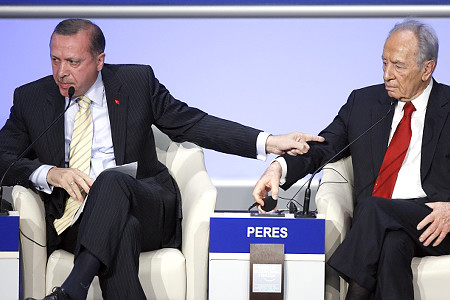
What Turkish PM Tayyip Erdogan Told Shimon Peres in Davos

"When it comes to killing, you know very well how to kill."
- Tayyip Erdogan, Prime Minister, Turkey

Tayyip Erdogan, Prime Minister of Turkey delivers a powerful condemnation of Israel to Shimon Peres at the World Economic Conference at Davos

World Economic Forum
February 3, 2009

Turkish Prime Minister Recep Tayyip Erdogan says he is done with Davos.

Turkey's Prime Minister Recep Tayyip Erdogan finished his weeks of sharp criticism of the Israeli war on Gaza with an unprecedented outburst of emotion meant to guard the honor of the Turkish nation.
"I attended the panel discussion 'The Case for Middle East Peace' held on the sidelines of the World Economic Forum in Davos, Switzerland as the prime minister of the Republic of Turkey. My responsibility is to protect the honor of the Turkish nation". - Prime Minister Recep Tayyip Erdogan upon his return to Turkey
The complete text of Erdogan's words to Peres are provided below this You Tube Video (with subtitles in English).


Mr. Erdogan:

"Mr. Peres, you are a senior citizen and you speak in a loud voice. I feel that your raised voice is due to the guilt you feel.

"But be sure that my voice will not be raised as yours,"

"When it comes to killing, you know very well how to kill,"

"I know very well how you hit and killed children on beaches."

"In your country there are two former prime ministers whose comments on Gaza are important for me."

"You had prime ministers who said: We relish the opportunity to enter the Palestinian lands on tanks."

"You talk to me with numbers. I am willing to name these people and among you there may be people who are longing to know who they are."

"I condemn those who clap for these atrocities, because I think that cheering the murderers of children and humans is in its kind a crime against humanity."

"Pay attention please, we can't disregard this fact."

"I have made notes of Mr. Peres's speech but I have not the time to answer all of them now."

(The moderator tries to stop the Prime Minster.)

"Let me finish"

"I will only touch on two points"

"First, the sixth of the Ten Commandments in the Torah says "You shall not kill" but in Palestine people are killed."

"And second, which is a very interesting issue; Gilad Atzmon [a Jew himself], says Israeli barbarity is far beyond any usual cruelty."

Aside from this, Avi Shlaim, Professor of Oxford who performed his military duty in the Israeli army says in the Guardian that Israel has become "a rogue state."

(The Moderator tries to interrupt the Prime Minister, with hand gestures and physical contact. Erdogan has a sudden flush of anger and turns to the moderator)

"I thank you so much I thank you, too. From now on, Davos is done for me. I will not attend Davos again. You don't let me speak."

"(Pointing to Peres) He spoke for 25 minutes, but you only let me speak for 12 minutes. This is not acceptable."

Erdogan picks up his notes and without looking at Peres and Ban Ki-moon leaves the session.

On his way out, the Arab League Secretary-General, Amr Mousa, stands up and appreciative of Erdogan's move shakes hands with him.

(Neither the photos nor the text of Mr. Erdogan's speech are to be found on the website of the World Economic Forum.)

War of Words Between Israel and Turkey Sparks Formal Complaint

CNN
February 14, 2009

Turkey's Foreign Ministry summoned Israel's ambassador to the Turkish capital of Ankara on Saturday to issue a formal complaint over a top Israeli commander's reported remarks criticizing Turkey.

The complaint is part of the escalating war of words between the two regional allies, stemming from Turkey's outspoken criticism of the recent conflict in Gaza.

The Turkish Foreign Ministry said Saturday that it had requested an "urgent explanation" from Ambassador Gabby Levy for recent remarks reportedly made by a top Israeli military commander.

According to the Israeli newspaper Ha'aretz, Maj. Gen. Avi Mizrahi told an international conference that Turkish Prime Minister Recep Tayyip Erdogan should "look in the mirror" before criticizing Israel.

Mizrahi pointed to Turkey's treatment of its long-oppressed Kurdish minority and the ongoing Turkish military occupation in northern Cyprus, Ha'aretz reported.

And, in a separate statement issued Saturday, the Turkish military called the Israeli general's comments "unacceptable," adding, "We expect the Israeli General Staff, which we think gives importance to relations with the Turkish Armed Forces, to clarify the issue."

Tensions have increased between Turkey and Israel since last month, when Erdogan stormed off stage at a conference in Davos, Switzerland.

Erdogan objected to Israeli Prime Minister Shimon Peres' passionate defense of Israel's 22-day military operation in Gaza, which left more than 1,300 Palestinians dead. Thirteen Israelis, including 10 soldiers, were killed.

For the past decade, Turkey and Israel have enjoyed close military and economic ties. The Israeli military often conducts exercises around the Turkish city of Konya. Israeli tourists flock to Turkey's Mediterranean Sea resorts, and bilateral trade has increased dramatically since Erdogan's ruling AK Party first won national elections in 2002.

As a result, audience members were shocked last month when Erdogan lost his temper while participating in a panel discussion of the recent Gaza conflict in Davos.

Before storming off stage, Erdogan told the Israeli president,

"When it comes to killing, you know killing very well. I know how you hit, kill children on the beaches."

Erdogan has been unapologetic about his outburst. While campaigning for municipal elections to be held in Turkey next month, the prime minister told reporters that the results of Israel's recent elections "painted a very dark picture" for the future of the region, Reuters reported.

A Conflict with Turkey Would Mean the Suicide of Israel

By Ahmet Turan Ayhan
February 5, 2009

Let's have a flashback about the Palestine cause: Israel played the world like a fish and made itself seem like a big playmaker by holding the initiative consistently.

Led by Yasser Arafat, the Palestine Liberation Organization (PLO) drove rock-throwing little children against Israel's strategic moves, and Israel could not overcome this for a long time.

Arafat's leadership did not allow Israel to pull all the strings in the region with its moderate and elastic policy. Holding the initiative and playing the field was not that easy for Israel in those years. Carrying out shuttle diplomacy among Arab states, Arafat knew how to turn the Palestine issue into one of the most important causes in the Muslim world. Thus, the Palestine issue was never an easy pill for Israel to swallow; even the US did not spare its support.

Following the death of Arafat, things got easier for Israel because of the conflict between Hamas and Fatah. We can say that this bicephalous structure increased Israel's desire for the region even more and unfortunately could not mount a resistance against Israel in Palestine. Another gap that Israel has benefited from is the veiled or open conflict between Hamas and Arab states. And Arab countries that see Hamas as a threat to themselves have been on the same page as Israel: Hamas should be demolished. Countries such as Saudi Arabia, Jordan and Egypt have shown virtually no reaction to Israel's latest operations for that reason.

The Israeli policy that drives the country forward is its friction with 'radical Iran' and its challenges against Iran. So, a conflict with Prime Minister Erdoğan, who has taken the initiative for stability and peace in the region and who has become one of the most respected leaders in the world -- a conflict with Turkey -- would be the end of Israel's survival strategy in the region

The Palestine issue is also evaluated as a "buffer zone" between the Arab and Western worlds. The Israeli threat was a disturbing issue for the Arab world, and Israel could be kept busy by supporting Palestine against Israel. Thus, the support of Arab countries for Palestine never crossed to the other side of the retaining wall. And Israel, being the only country whose borders the United Nations could not define, continued to expand its land with its ongoing invasion of Palestinian land.

Dividing Palestine into the two tiny regions of the West Bank and Gaza, Israel nearly erased Palestine from the world map. As it was expanding its land and deepening its invasion, Israel took advantage of "Islamophobia" very often to convince the Western world; Israel represented itself to the Western world as a country that was fighting against "Islamic terrorism" and tried persuade the Western world by saying it was eliminating that threat for the sake of the whole world, and this is still taking place.

The lack of a reaction from the Western world against Israel should not be attributed only to the influence of Jewish lobbies, but also to the success of Israel's strategy of convincing Westerners through fictionalized Islamophobia rhetoric.

Does Israel have its back against the wall?

Israel lost the war in Lebanon in 2006 in military aspects and lost the war in Gaza (2008) in ethical aspects. If we consider domestic politics in Israel, it seems as though political parties will not meet their expectations in terms of collecting votes. Maybe Israel will achieve the political aims it has planned in the short term, but it will suffer because of its image as a "murderer state" in the long term.

Turkish Prime Minister Recep Tayyip Erdoğan communicatively expressed "the truth that all the people on the planet agree on" to Israeli President Shimon Peres in Davos. Actually his reaction to the Israeli president in Davos created a bigger impression than leaving the Davos meeting. In diplomatic language, the phone call made by Israeli President Peres to Erdoğan indicating that he was not offended by what happened can only be evaluated as the desire to shift from the image of a "murderer state" to a more personal one.

We should underscore that predictions about the future that await Israel are not definite. Israel incited the reaction of the world with the barbarian slaughter it carried out, and it appears that Israel's propaganda, which deliberatively reduces Gaza to "Hamas," cannot be handled even by Nobel Peace Prize winner Peres.

As long as Israel does not trigger a new process after the crime against humanity it committed in Gaza, it will start to eat up its own energy internally. Above all, a political crisis with Turkey in this period would mean the suicide of Israel. The Israeli policy that drives the country forward is its friction with "radical Iran" and its challenges against Iran. So, a conflict with Prime Minister Erdoğan, who takes initiative for stability and peace in the region and who has become one of the most respected leaders in the world -- a conflict with Turkey -- would be the end of Israel's survival strategy in the region.

Can Israel take such risk, which may cause it to turn from a country that holds the initiative and produces policy into a country that is shaped by others' policies? Essentially the situation is that. At this stage, it should be stated that Israel may find itself in such a situation whether it wants to or not, since international developments that are likely to take place imply that this may take place. Peres' phone call to Erdoğan to express his sorrow over what happened was not for nothing. The thing that Peres could not handle, more than Erdoğan's personality, was the strength and success of Turkish diplomacy under the leadership of Erdoğan.

Is the Davos crisis a great chance for Turkey?

The point at which Israel has arrived can be defined as "go farther and fare worse." Israel may recognize itself as having achieved certain aims (especially political aims) through the operation in Gaza, which was planned considering the nature of the soil there -- an operation that was planned very well tactically just before the Obama administration took office. But Israel's policy of producing tension in the region is taking a jab starting from today.

Now there is a peaceful country, Turkey, between Israel and Iran (the country Israel has continuously used as a foundation for its legitimacy). Turkish diplomats know how to bring Hamas and Israel together at the same table through their practices of peace and shuttle diplomacy, and now this has turned into a strong barrier for Israel. Turkey can succeed in limiting Israel by taking the initiative in the region and bridling both Palestine and Israel and another actor in the region, Iran. Moves that weaken the hand of Israel politically are made by Turkey.

Turkey can turn the crisis in Davos into an opportunity, and this has become possible because of a historical turning point in the meeting in Davos that occurred when Mr. Erdoğan (as he should have) left a panel discussion after an argument with the Israeli president. While the Turkish media discuss whether the behavior of Prime Minister Erdoğan was right, Erdoğan's action, which can be defined as active, smart and not to be outdone, has carried Turkey into a key position. Now, what is the probability that this attitude and this occasion will be turned into a stable one in the international arena? This aspect of the issue deserves to be discussed.

One of the things that bothers Israel most is the possibility that Turkey may work out a stable peace between Hamas and Fatah. This is one of the opportunities that await Turkey, and Turkey will increase its influence through its success in this. We should not be surprised if we witness such an initiative by Turkey.

[*] Ahmet Turan Ayhan is a political analyst.

Back to The Lamb Slain Home Page